PV cleaning equipment manufacturer
PV cleaning equipment manufacturer

Can You Pressure Wash or Brush Solar Panels? What 12 Maker Manuals Allow
Can you pressure wash solar panels? We read 12 module maker manuals: written limits run from 675 kPa to 10 MPa, and brush rules differ.

The short answer
The manuals do not give one answer, because the makers do not agree. In our reading of 12 module makers’ manuals, nine publish a maximum water pressure, and the figures run from 675 kPa (98 psi) to 10,000 kPa (100 bar), a spread of 14.8× (5.9× if the single highest figure, from Maxeon’s IEC edition, is set aside). Qcells, REC and Astronergy give no figure, and REC’s IEC manual says high pressure hoses and cleaners are not permitted. A consumer electric pressure washer is rated at 1,300–2,000 psi (8,963–13,790 kPa), which is 2.2× the 4 MPa figure that four makers use and 13.3× the lowest. A garden hose on a home supply at the EPA WaterSense cap of 60 psi (414 kPa) sits below every maker’s figure. On brushes, the makers that name tools describe soft cloths, sponges or fine nylon bristles; Canadian Solar and Maxeon’s IEC edition caution against rotating or spinning brushes, and Aiko says not to use a hair brush or other rough tools.
We found no published measurement of pressure-washer damage to modules and none of cold-water thermal shock, so the pressure and temperature limits are maker instructions, not test results. The abrasion data that do exist come from laboratory brush tests on small samples of coated glass. The practical rule that follows is to find the manual for the exact module and edition in front of you, use the figure it gives at the point it names, and ask the maker in writing when it gives none. Section 7 is a checklist.
Section 1 puts the pressure figures in everyday units, Section 2 lists what 12 manuals say, Section 3 explains why the figures differ, Section 4 covers water temperature and quality, Section 5 covers brushes, robots and our own products, Section 6 covers what the damage research shows and does not show, and Section 7 is the checklist.
Scope and disclosure. This article answers one question: how much pressure and what kinds of brush and tool the module makers allow. Water chemistry is in Can You Clean Solar Panels With Tap Water?, how well dry and wet methods remove soiling in Dry vs Wet Solar Panel Cleaning, how often to clean in How Often Should You Clean Solar Panels? and robot economics in Are Solar Panel Cleaning Robots Worth It?. We make cleaning equipment (the G-series brushes and the R-series robots), so Section 5 states what our product pages say and that we have not tested any of our machines against any maker’s cleaning conditions. We read the manuals on 3 November 2026, in the editions listed under Sources. Manuals are revised (Section 3), so check the date on yours. Our product pages publish no prices, so this article gives none.
1. The pressure figures in everyday units
Makers write pressure in kPa, MPa, bar or psi. One bar is 100 kPa, 1 MPa is 10 bar or 1,000 kPa, and 1 psi is 6.895 kPa (our conversions). Table 1 lines up the reference points used in this article.
Table 1. Reference pressures used in this article.
| Reference point | kPa | psi | bar | Source |
|---|---|---|---|---|
| EPA WaterSense cap on static service pressure in labelled new homes | 414 | 60 | 4.1 | EPA WaterSense New Home Specification v1.1 |
| Optional pump listed on our G1 page | 414 | 60 | 4.1 | G1 product page |
| Lowest figure in a maker manual (JinkoSolar, hose or backpack set) | 675 | 98 | 6.8 | Table 2 |
| Most common figure in a maker manual (4 MPa: four makers) | 4,000 | 580 | 40 | Table 2 |
| Highest figure in a maker manual (Maxeon, IEC edition) | 10,000 | 1,450 | 100 | Table 2 |
| Consumer electric pressure washers, rated | 8,963–13,790 | 1,300–2,000 | 90–138 | Greenworks buying guide |
| Consumer gas pressure washers, rated | 19,305–27,579+ | 2,800–4,000+ | 193–276+ | Greenworks buying guide |
A hose connected to a supply at the WaterSense cap delivers 61% of the lowest maker figure (our arithmetic: 414 ÷ 675). Homes built before the specification, and supplies in other countries, can differ, so treat 414 kPa as a reference point and not as a guarantee. The pressure-washer ratings come from a pressure-washer maker’s own buying guide, which says most electric models range from 1,300 to 2,000 psi and gas models often from 2,800 to 4,000+ psi.
Two cautions apply to every comparison in this article. First, a washer’s rating is the pump’s output, not the pressure that reaches the glass, which depends on the nozzle, the standoff distance and the angle. None of the manuals we read gives a way to convert one into the other. Second, the maker figures are defined at different points (Section 3). The comparison shows scale only: even the lowest electric rating is 2.2× the 4 MPa figure.
For a sense of scale (our calculation, using the ideal nozzle exit speed of water, v = √(2P/ρ), with no losses): 36.7 m/s at 675 kPa, 89.4 m/s at 4 MPa and 141.4 m/s at 100 bar. These are upper bounds at the nozzle, not speeds at the glass. They show that a 14.8× spread in pressure is a 3.85× spread in jet speed, because speed rises with the square root of pressure.
2. What 12 module makers’ manuals say about water pressure
Table 2 lists every maker whose manual we could read, with the edition and what it says about pressure. Nine publish a figure (ten figures in all, because JinkoSolar gives two). Three do not. The wording differs from “recommend” to “must not exceed”, and we give it as the manual does.
Table 2. What 12 module makers’ manuals say about water pressure.
| Maker and edition | What the manual says about pressure | Figure | Where it applies |
|---|---|---|---|
| First Solar, Series 6 Plus User Guide, REV 2.5 (July 2026) | “Water temperature must be < 20°C from module temperature applied with water pressure < 35 bar (500 psi) at nozzle.” | <35 bar (500 psi) = 3,500 kPa | At the nozzle |
| Trina Solar, Vertex manual UM-M-0002 Ver. M (February 2025) | “The recommended maximum water pressure is 4 MPa (40 bar)” | 4 MPa (40 bar) = 4,000 kPa | Not stated |
| Canadian Solar, installation manual US-Rev 3.3 (July 2026) | “a maximum water pressure not exceeding 4 MPa (40 bar)” | 4 MPa (40 bar) = 4,000 kPa | Not stated |
| JA Solar, cleaning method, Portuguese edition (October 2022) | Water pressure “must be below” the figure (our translation of “deve ser inferior a”) | 690 kPa (100 psi) | Not stated |
| JinkoSolar, Cleaning Manual v1.0 (October 2024) | “If using a hose or backpack-style pressure set, we recommend a water pressure less than 675kPa.” and, for pressurized flow, “it is recommended that the water pressure do not exceed 3500 kPa (35 bar), and the nozzle is kept at a distance of at least 0.5 meters from the panel.” | 675 kPa (hose or backpack set); 3,500 kPa (pressurized flow) | Not stated for the hose figure; nozzle at least 0.5 m from the panel for the flow figure |
| LONGi, O&M manual version 02 (January 2024) | “the water pressure on the surface of the module shall not exceed 0.7Mpa.” | 0.7 MPa = 700 kPa | On the surface of the module |
| Risen Energy, installation and maintenance manual, edition A1[2026] | “the water pressure on the glass surface of the module must not exceed 4 MPa”; elsewhere “The recommended maximum water pressure is 4 MPa (40 bar)” | 4 MPa = 4,000 kPa | On the glass surface |
| Aiko, installation manual V35 (September 2026) | “Recommended maximum water pressure is 4MPa(40bar)” | 4 MPa (40 bar) = 4,000 kPa | Not stated |
| Maxeon, IEC edition Rev AD (September 2024); US edition Rev J (December 2025) | IEC: “Normal water pressure is more than adequate, but pressurized water up to 100 bar (min.50 cm distance) may be used.” US: “Normal water pressure is adequate when cleaning the AR glass.” and, for large systems, rinse “with high-pressure water or a soft squeegee” | IEC: 100 bar = 10,000 kPa. US: no figure | IEC: minimum distance 50 cm |
| REC, Alpha Pure manual REV 18 (March 2026), IEC edition; quick guide to cleaning | IEC: “Use of high pressure hoses or cleaners is not permitted as these may damage the panels, laminate or cells.” Quick guide: “A standard flexible garden hose with domestic water pressure may be used”, but “The use of pressure or steam cleaners and high pressure hoses, knives, blades and metallic sponges is not permitted on REC panels and will invalidate the warranty.” | No figure | — |
| Qcells, Q.TRON XL-G2.3 manual rev 11 (September 2026, North America) | No pressure figure. “each customer is free to choose the method of cleaning. However, possible damages, caused by the cleaning or related to the cleaning tools or agents shall not be covered by the module’s Product and Performance Warranty.” | No figure | — |
| Astronergy, installation manual Rev 3.0 (August 2026) | No pressure figure. “For more details on cleaning and maintenance, please refer to the PV Module Cleaning Manual.” We could not find that separate manual. | No figure | — |
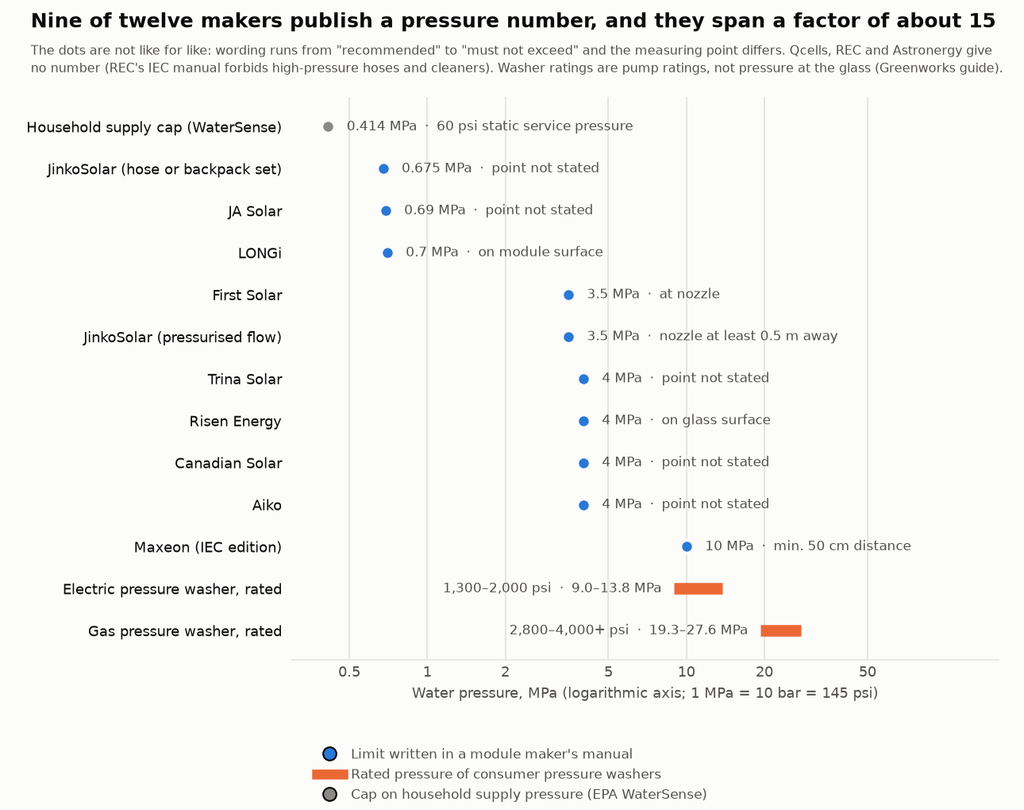
Our reading of Table 2 has four parts. First, the figures cluster in three groups: 675–700 kPa (JinkoSolar’s hose figure, JA Solar, LONGi), 3,500–4,000 kPa (First Solar, JinkoSolar’s pressurized-flow figure, and the four makers at 4 MPa) and Maxeon’s 10,000 kPa, with nothing between 700 and 3,500 kPa. Second, the lowest group is in the range of a household supply: the WaterSense cap is 61% of the lowest figure. Third, the electric pressure-washer range (about 9–14 MPa) straddles the single highest figure, 10 MPa, and sits well above the other nine. Fourth, JinkoSolar ties the allowed pressure to the equipment (hose or backpack set against pressurized flow with a standoff distance), which is the only maker that does so in the passages we read.
Maxeon’s IEC wording reads differently from its figure. The sentence is “Normal water pressure is more than adequate, but pressurized water up to 100 bar (min.50 cm distance) may be used”, and the same passage says that “cleaning without consultation will invalidate the product warranty”. LONGi’s manual says “For large-scale power stations, high-pressure cleaning vehicles can be used to tangentially or positively impact PV modules to achieve the effect of dust removal” and, in the same manual, caps the pressure on the module surface at 0.7 MPa. The manual does not reconcile the two, and we cannot either. If you operate such equipment, ask LONGi which one governs. First Solar’s guide has a scope note saying it is not intended for residential use in the USA or for rooftop applications, so, in our reading, its figure is written for plants and not for roofs.
3. Why the figures differ, and what they hide
Five of the ten figures name no measuring point
Three figures name a point: First Solar says its figure applies “at nozzle”, LONGi “on the surface of the module” and Risen “on the glass surface”. Two give a minimum nozzle distance instead: JinkoSolar’s flow figure (at least 0.5 m from the panel) and Maxeon’s (50 cm). The other five figures (JinkoSolar’s hose figure, JA Solar, Trina, Canadian Solar, Aiko) name no point. In our reading, a limit at the nozzle is stricter on the equipment than the same limit at the glass, because the pressure of a jet falls between the two. Our judgement is that a figure with no stated point should be read at the nozzle, since that is the number you can check against a washer’s rating.
The wording runs from advice to prohibition
JinkoSolar writes “recommend”, Trina and Aiko “recommended maximum”, Canadian Solar “not exceeding”, LONGi “shall not exceed”, Risen “must not exceed” (and also “recommended maximum” in its water-requirements list), and First Solar and JA Solar “must be below” (JA Solar in our translation). Whether a “recommended maximum” is enforceable under a warranty is a question for the maker, and we do not read it for you. Eight of the 12 manuals also say that damage from improper cleaning is not covered by the warranty (Section 5).
The same maker’s figure has moved between editions
Table 3. Earlier and current editions of the same maker’s manual.
| Maker | Earlier edition | Current edition we read | Change |
|---|---|---|---|
| Trina Solar | PS-M-0906 Ver C, January 2021: pressure on the glass surface of the module 700 kPa; irradiance up to 200 W/m²; TDS up to 1,000 mg/L | UM-M-0002 Ver. M, February 2025: 4 MPa, point not stated; the July 2022 edition (excerpt we read) already says 4 MPa | 5.7× higher figure, and the stated point (glass surface) was dropped. UM-M-0002 lists 13 editions between April 2021 and February 2025 |
| Risen Energy | RS/03-MTP-015-2019 B/0, April 2019: 700 kPa; irradiance up to 200 W/m² | A1[2026]: 4 MPa on the glass surface | 5.7× higher figure |
| Canadian Solar | EN-Rev 2.2, July 2020: “Canadian Solar Inc. recommends to avoid rotating brush cleaning methods, as they could create micro-cracks in the PV modules.” | US-Rev 3.3, July 2026: “For cleaning methods using rotating brush, please consult with Canadian Solar’s technical service team in advance.” | From a recommendation to avoid rotating brushes to a request to consult first. The 4 MPa figure is the same in both |
| Qcells | Q.PEAK DUO ML-G9.X-AC rev 01, August 2021: “Do not use surfactants, rotating brushes, scrapers, or any high-pressure water cleaning equipment.” and “No dry cleaning or use of rotating brushes.” | Q.TRON XL-G2.3 rev 11, September 2026: “each customer is free to choose the method of cleaning. However, possible damages, caused by the cleaning or related to the cleaning tools or agents shall not be covered by the module’s Product and Performance Warranty.” | From a ban list to the customer’s choice, with a warranty exclusion for damage |
| REC | IEC edition REV 18: “Use of high pressure hoses or cleaners is not permitted as these may damage the panels, laminate or cells.” | UL (North America) edition, REV 18: has the thermal-shock line and the soft-brush line but not the sentence about high pressure hoses | The two editions of the same revision differ. The quick guide bans pressure cleaners outright |
| Maxeon | IEC edition Rev AD: pressurized water up to 100 bar, min. 50 cm | US edition Rev J: “Normal water pressure is adequate when cleaning the AR glass.”; for large systems “high-pressure water or a soft squeegee” | Regional editions differ; the US edition gives no figure |
Trina’s and Risen’s figures rose by a factor of 5.7 between the editions we compared, Canadian Solar’s wording on rotating brushes softened, and Qcells moved from a ban to the customer’s choice. In the passages quoted here, none of the makers gives a reason for the change, so we cannot say whether the older limits were over-cautious, the newer ones are looser because of redesigned glass or sealing, or the two were never based on the same test. What the table does show is that a limit copied from a manual several years old, or from a different region’s edition, may no longer be the maker’s position. This is also why the figures on third-party pages, including ours, should be checked against the current document.
Only one maker explains its reason
REC’s quick guide is the only document we read that says why. It says the use of high pressure hoses is not permitted “as these may exert pressure in excess of the certified load and cause impact damage, damage to the frame bonding, the laminate or cells and force water between the glass and frame”. That is a mechanism, not a measurement: REC gives no pressure at which any of these starts. It is, however, a reason that applies to every maker’s modules in principle, and it is the one a reader can weigh against a washer’s jet.
4. Water temperature, time of day and water quality
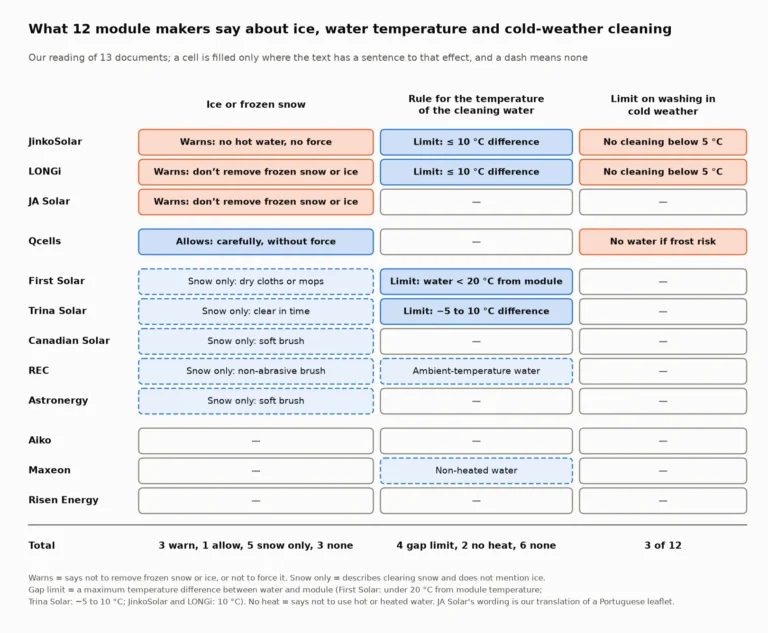
Pressure is not the only condition. Several makers cap the temperature difference between the water and the glass, ask for low sunlight, and set water-quality limits. Table 4 lists what we read. For the chemistry behind the water limits, see our tap-water article.
Table 4. Water temperature, time of day and water quality.
| Maker | Water against module temperature | Time of day or sunlight | Water quality |
|---|---|---|---|
| JinkoSolar | Difference up to 10 °C; no cleaning when ambient temperature is below 5 °C (to avoid freezing and cracking of the glass) | Not around noon; irradiance up to 200 W/m² | TDS up to 1,000 mg/L; pH 6.5–8; hardness up to 450 mg/L |
| LONGi | Difference up to 10 °C; no cleaning when ambient temperature is below 5 °C (same reason) | Recommended irradiance up to 200 W/m²; early morning, dusk, night or rainy day | TDS up to 1,000 mg/L; pH 6–8; hardness up to 450 mg/L |
| Trina Solar (Ver. M) | −5 to +10 °C | “Do not clean the modules during the hottest time of the day to avoid thermal stress on the modules.” | pH 6–8; hardness up to 600 mg/L; soft water recommended |
| First Solar | Below 20 °C | “The recommended time to clean modules is from dusk to dawn” | TDS below 1,500 mg/L; pH 6.5–8.5 for the final solution if a detergent is used |
| Risen Energy | Not stated | Early morning or evening suggested | pH 6–8; hardness up to 600 mg/L; “Demineralized water is recommended.” |
| REC | “only water at ambient temperature should be used” (quick guide) | “Panel cleaning must always be carried out when the panels are cool, e.g., early morning, to avoid breakage through thermal shock.” | “Use only deionized water free from grit and physical contaminants” |
| Maxeon | “potable, non-heated water” (US edition) | IEC edition: not to clean at high outside temperatures | Not stated |
Canadian Solar also asks for water with low mineral content and a pH of 6–8. REC explains the temperature rule: “Applying cool, cold or lukewarm water to hot panels can cause components (e.g., glass) to shrink rapidly, potentially causing cracks and breakages.” The mechanism it describes is thermal shock. We searched for measured data on glass breakage from cleaning-water temperature and found none, so the 10 °C and 20 °C limits stand as maker instructions without a published basis that we could find.
5. Brushes, rotating heads and robots
Table 5 sets out what each maker says about tools, robots and warranty. A dash means we found nothing on that point in the passages we read, and we do not read silence as permission.
Table 5. What each maker says about brushes, robots and warranty.
| Maker | Brushes, cloths and other tools | Robots and automatic equipment | Warranty wording |
|---|---|---|---|
| First Solar | Requirements: “Load while cleaning must not exceed 40.8 kg (90 lbs.) per module and must be evenly distributed.” and “Brush load (P3) – maximum of 0.18 kg/cm (1 lbs./inch) of contact length for brushes in contact with the module at any location.” Recommendation (not mandatory), in order of preference: wet non-contact methods, soft mops or soft cloths, soft brushes. “Do not direct pressurized water at sealed interfaces of module (junction box, edge seal, and connectors).” | Covers manual, robotic and mechanized systems under the same load limits | “First Solar does not warrant against breakage, damage, wear, or module performance issues that are determined to be caused by module cleaning.” |
| Trina Solar (Ver. M) | “Use a dry or wet, soft and clean cloth, sponge, or soft bristled brush to wipe the photovoltaic module.” “Do not use steam cleaner.” | “If a cleaning robot is used for dry cleaning, the brush material is required to be soft plastic material”; “The weight of the cleaning robot should not to be too large.” | Robot damage: “module damage and power attenuation are not covered by Trina Solar’s warranty”. General: “Damages caused by failure to clean or improper cleaning procedures will void Trina Solar warranty.” |
| Canadian Solar (v3.3) | “Noticeable dirt must be rubbed away by gentle cleaning implement (soft cloth, sponge or brush with soft bristles).” “Dirt must never be scraped or rubbed away when dry, as this will cause micro-scratches on the glass surface.” | “For cleaning methods using rotating brush, please consult with Canadian Solar’s technical service team in advance.” “Improper cleaning equipment design may cause localized heavy loads onto the module.” | “The module damage due to improper dry cleaning method will void Canadian Solar’s warranty.” |
| JinkoSolar | “Various soft foam materials, non-woven fabrics, brooms, soft sponges, soft brushes, and brushes with nylon thread that have a diameter of 0.06-0.1mm can be used.” | “Modules can be cleaned with automatic cleaning equipment. During the cleaning process, the requirements for the use of automatic cleaning equipment must be followed, and modules must be protected from damage.” | “Damages induced by inappropriate cleaning procedures will void the Jinko Solar warranty.” |
| LONGi | “Various soft foam materials, non-woven fabrics, brooms, soft sponges, soft brushes and brushes whose diameter of nylon thread is 0.06-0.1mm can be used.” | “LONGi modules can be cleaned with automatic cleaning equipment.” “If you are not sure whether the automatic cleaning equipment will cause damage to modules, you can consult the customer service personnel of LONGi.” | — |
| JA Solar | Nylon 1010 bristles, 0.06–0.1 mm, for anti-reflection glass | — | — |
| Aiko | “Do not clean PV modules with a hair brush or other rough surface tools.” | Robot weight not more than 40 kg | “the PV module damage and power degradation caused by improper cleaning with the cleaning robot are not covered by the warranty of AIKO” |
| Maxeon | IEC: “As dry cleaning is also risky for Anti-Reflective (AR) coated module surface, spinning brush is not recommended for module cleaning.” US: soft sponge or seamless cloth | — | US: “Do not use harsh industrial-strength cleaning materials such as scouring powder, steel wool, scrapers, blades, or other sharp instruments to clean the module glass. Use of such materials will void the product warranty.” IEC: “Use of such materials or cleaning without consultation will invalidate the product warranty.” |
| Risen Energy | “Use dry or wet soft cloths, sponges, etc. to clean the modules”, but “do not wipe the PV modules with hard objects”. “The module must not be subjected to additional external force.” | — | — |
| REC | Sponge, microfiber cloth or soft brush; soft rubber squeegee. Quick guide: knives, blades and metallic sponges not permitted | — | “The use of pressure or steam cleaners and high pressure hoses, knives, blades and metallic sponges is not permitted on REC panels and will invalidate the warranty.” |
| Qcells | Current: “each customer is free to choose the method of cleaning. However, possible damages, caused by the cleaning or related to the cleaning tools or agents shall not be covered by the module’s Product and Performance Warranty.” 2021 edition: Do not use surfactants, rotating brushes, scrapers, or any high-pressure water cleaning equipment. | — | Damage “shall not be covered by the module’s Product and Performance Warranty” (current edition) |
| Astronergy | Rinse with water and no detergent; “use a gentle sponge or brush” in the cooler hours. “Dust must not be scraped or wiped off under dry conditions as this may result in tiny scuff marks.” Refers to a separate cleaning manual that we could not find | — | — |
Four things stand out. First, the three makers that give a bristle specification agree: nylon, 0.06–0.1 mm (JinkoSolar, LONGi and JA Solar). Second, First Solar is the only maker that sets mechanical limits for tools: a total load of 40.8 kg per module and 0.18 kg per centimetre of brush contact length, which for a 1 m contact line is at most 18 kg (our arithmetic). Third, the makers that mention rotating brushes are cautious: Canadian Solar asks for consultation in advance, and Maxeon’s IEC edition says a spinning brush is not recommended because dry cleaning is risky for anti-reflective coatings. Fourth, Trina and Aiko address robots directly: both require a soft plastic brush for dry cleaning (in near-identical wording, in Trina’s Method D and Aiko’s Method C) and both exclude damage from improper robot use from the warranty.
Where our own products stand
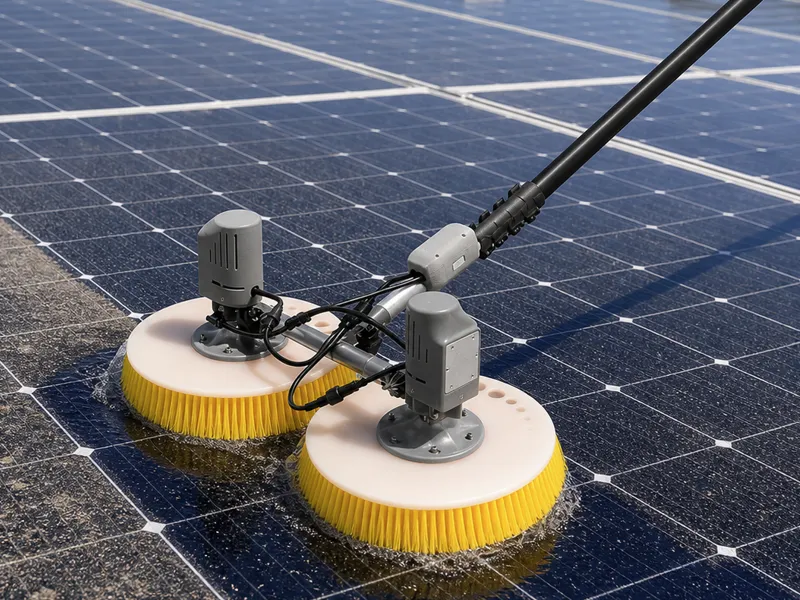
This is what our product pages say, fetched on 3 November 2026, and nothing more. The G1 is an unpowered water-fed brush with PBT bristles, and its page says “No powered rotating brush”. It has an optional 6.0 LPM pump rated at 60 psi / 4.1 bar (414 kPa), and its optional accessories are listed as “Scraper, web brush, dust duster, soap dispenser”. The G2U, G3, G3U and G4 are powered heads with a listed brush speed of 260 RPM: a 45 cm disc brush (G2U), small disc brushes in a 70 cm double head (G3), large disc brushes up to 95 cm (G3U) and a 60 cm roller brush (G4). The G2U, G3 and G3U pages list water cleaning, the G4 page lists wet or dry cleaning, and all four list a maximum water flow of 4 L/min. The R1 and R2 robots use nylon / PBT brushes with dry and water modes, at 260 RPM (R1) and 340 RPM (R2). The G2U page says to avoid excessive pressure on module glass, and the R1 page says dry cleaning should be selected only when the dust and module conditions are suitable.
What the pages do not publish is a bristle diameter, a brush contact load in kg per centimetre, or a water pressure at the glass for the G2U, G3, G3U, G4, R1 and R2. We have not tested any of our machines against any maker’s cleaning conditions, and we make no statement that any of them complies with any manual in Table 5. The practical consequence is narrow. Our powered heads rotate, so on modules covered by Canadian Solar’s or Maxeon’s manuals the first step is to ask the maker, as it is for any rotating brush. Our G1 accessory list includes a scraper and a soap dispenser. The 2021 Qcells edition prohibited scrapers and surfactants, and Maxeon’s US edition lists scrapers among the materials whose use will void its warranty. The G1 pump’s rating is 61% of the lowest figure in Table 2, but a rating below a limit does not make a machine compliant, because the brush, water, temperature and load conditions apply as well.
6. What the damage research shows, and what nobody has measured
Pressure and brush limits are only as good as the evidence behind them, so we looked for the evidence. IEA PVPS Task 13 (2022) is direct about the gap: “There is no international performance and functionality standard with pass/fail criteria for the cleaning of PV modules.” It also notes that module manufacturers typically specify a maximum pressure and that warranties may be voided if these values are exceeded. NREL’s O&M best practices go further and advise: “Do not use high-pressure water, brushes, or any types of solvents, abrasives, or harsh detergents.” Table 6 lists the measurements we found.
Table 6. Measurements of abrasion and cleaning damage that we found.
| Study | What was tested | What it found | Limits |
|---|---|---|---|
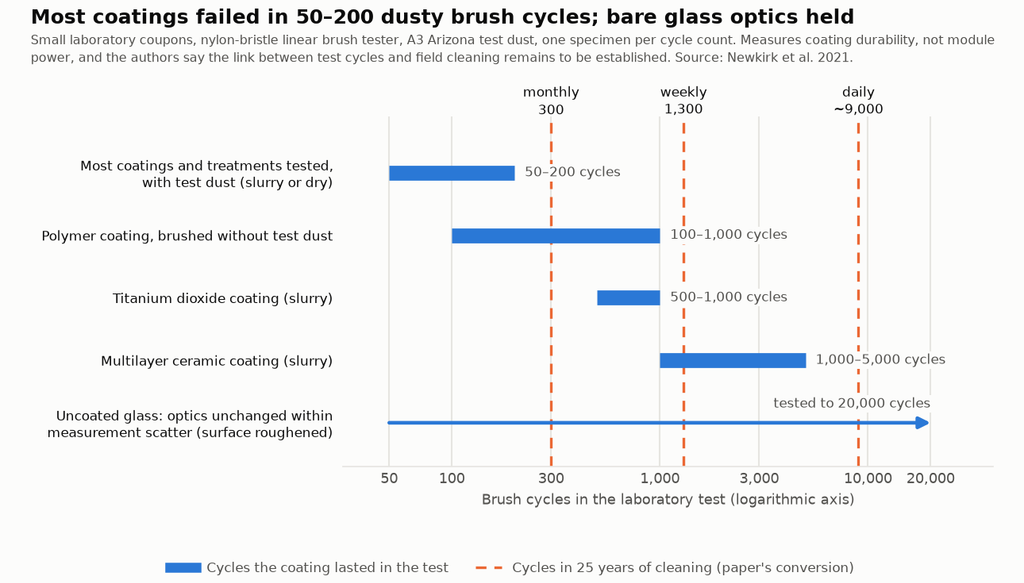
| Newkirk et al. 2021 (peer-reviewed; full text read) | Linear brush abrasion with a nylon-bristle brush and A3 Arizona test dust on small coated and uncoated glass coupons, up to 20,000 cycles | Most coatings and surface treatments tested lasted about 50–200 cycles with test dust. A polymer coating lasted 100–1,000 cycles without dust. In slurry tests with dust, titanium dioxide lasted 500–1,000 cycles and a multilayer ceramic 1,000–5,000. Uncoated glass: optical (diffuse transmittance, yellowness index) unchanged within measurement variation; contact angle fell and roughness Ra rose by more than 10 nm over 20,000 cycles. Damage began about an order of magnitude later with a soft-bristle brush | Small laboratory samples, one specimen per cycle count. The authors say the correlation with field cleaning remains to be established |
| Miller et al. 2020 (peer-reviewed; full text read) | Natural against artificial abrasion of PV glass, including different brush materials | “The greatest decrease in τh is seen for the Nylon brush.” “The hog bristle brush is the least damaging.” “glass with no coating can be cleaned many times (e.g., over years) before the performance of a PV module is affected” | Compares brush materials, not the bristle diameters in the manuals |
| Fraunhofer CSP test report V403/2018 (preliminary customer report; not peer-reviewed; full text read) | Linear brush abrasion with Arizona test dust A2 fine, 100 to 500 cycles | Bare glass: reflectance 4.5% unchanged after 500 cycles. A commercial anti-reflective reference went from 0.75% to 3% within the first 100 cycles. The report says “damage could be reduced by the use of wet cleaning techniques or rotating brushes (i.e. automatic cleaning robots) with low contact pressure” | Counts each stroke as one cleaning, so one cycle is two cleanings (Newkirk counts a full forward-and-back sweep as one) |
| Bomber et al. 2024 (abstract and NREL slides only) | Five-year field study of glass coatings | “The acceleration factor for dry brush cleaning of a porous silica coating was found to be on the order of unity.” | We read only the abstract and the slides |
| Figgis et al. 2024 (abstract only) | Robot cleaning of 9 module types over 18 months | “the abrasion resistance of PV modules varied greatly. Five kinds of module showed greater losses with more frequent cleaning, while the other four did not.” | We read only the abstract |
| Lange et al. 2022 (abstract only) | Abrasion of anti-reflective coatings under various conditions | “Using the hard Corundum dust, 1000 brush cycles lead to a relative loss in transmittance of about 3%.” | We read only the abstract |
How to read the laboratory numbers
In Newkirk’s own convention one cleaning is one cycle, so 50–200 cycles is about 1.0–3.8 years of weekly cleaning (our arithmetic, at 52 cleanings a year), but only if one test cycle with dust does the same damage as one field cleaning. The authors say that equivalence is not yet established. Bomber’s field study is the only evidence we found on it: for dry brush cleaning of one porous silica coating, the abstract reports an acceleration factor on the order of unity, which we read as one test cycle being about as damaging as one cleaning for that coating. That is one coating, from an abstract. Fraunhofer uses a different convention. It counts each stroke as a cleaning, so its table puts 100 cycles at 3.5–4 years of weekly cleaning. The same number of cycles therefore means twice as many cleanings in the Fraunhofer report as in Newkirk’s paper, and anyone converting a number of test cycles into years of cleaning should say which convention they use.
Three conclusions are supported by these studies, and we state them with their limits. First, coatings are where the damage shows up: bare glass kept its optical properties through 500 cycles in one study and 20,000 in another, while anti-reflective and other coatings degraded within hundreds. Even for bare glass, Newkirk reports a gradual fall in contact angle and a rise in roughness, so “unchanged” applies to the optical measurements only. Second, dust matters: Lange reports about 3% relative transmittance loss after 1,000 cycles with hard corundum dust, and Newkirk’s coatings lasted about 50–200 cycles with dust against 100–1,000 for the one polymer coating tested without it (the ranges overlap, so we draw no ratio). Third, how a brush touches the glass matters: Fraunhofer reports that damage could be reduced by wet cleaning or by rotating brushes with low contact pressure, and Newkirk found damage began about an order of magnitude later with a soft-bristle brush. Miller found nylon the most damaging of the brushes it compared and hog bristle the least. Three makers specify fine nylon bristles. A diameter specification and a material comparison are different variables, so these results neither contradict nor confirm each other, and we cannot tell from them which bristle suits your modules.
What nobody has measured
We found no measured data on the damage a pressure washer does to a module, at any pressure, and none on glass breakage from the temperature of the cleaning water. We also found no study that links the pressure figures in Table 2 to a failure threshold. The limits in the manuals may rest on the makers’ internal tests, which are not published in the documents we read. Until someone publishes a test, the defensible position is the one in the manuals themselves: follow the maker’s figure, and when it is missing, ask.
7. A checklist before you reach for a pressure washer or a brush
- Get the manual for your exact module model, and note its edition date. Trina’s UM-M-0002 alone has 13 editions between April 2021 and February 2025, and the limits changed (Table 3).
- Use the figure at the point it names. Our judgement is that when no point is named (five of the ten figures in Table 2), you should read it at the nozzle, which is the stricter reading and the one you can check against a rating.
- If the manual gives no figure, ask the maker in writing. That covers Qcells, REC (whose IEC manual bans high pressure hoses and cleaners) and Astronergy, and any module whose manual you cannot find. Keep the reply with your cleaning records.
- Do not use a consumer pressure washer unless you can show the pressure at the glass is below the figure. The lowest electric rating is 2.2× the 4 MPa figure, and the manuals do not say how to measure pressure at the glass. A hose at household pressure is below every figure in Table 2, and REC’s quick guide says a standard garden hose with domestic water pressure may be used.
- Match the water to the module. Keep the water near the module’s temperature (within 10 °C at JinkoSolar and LONGi, and between −5 and +10 °C at Trina), clean when the sun is low and keep to the maker’s water-quality limits (Table 4).
- Keep tools soft and loads low. Fine nylon bristles or soft cloths and sponges; no scrapers, steel wool or abrasive cleaners; no scraping or rubbing of dry dirt (Canadian Solar’s rule); and, if you use a brush head, treat First Solar’s 0.18 kg per centimetre as the only published contact-load limit we found.
- Ask before using a rotating head, a robot or a dry method on Canadian Solar, Maxeon, Trina or Aiko modules, and read the robot clauses (soft plastic brush for dry cleaning, a weight limit of 40 kg at Aiko). A robot’s damage is excluded from the Trina and Aiko warranties when it is used improperly.
- Keep a cleaning record. Risen’s manual asks you to fill out a PV module cleaning record after cleaning. A record of method, pressure, water source and date is also what you need if a warranty claim is questioned. Our soiling-measurement article shows how to measure the effect of a cleaning, and our frequency article how often it is worth doing.
Frequently asked questions
Can you pressure wash solar panels?
Not as a general rule. Of the 12 makers we read, nine publish a maximum pressure between 675 kPa and 10,000 kPa, REC’s IEC manual says high pressure hoses and cleaners are not permitted, and three makers give no figure. A consumer electric pressure washer is rated at 8,963–13,790 kPa, which is at least 2.2× the 4 MPa figure and, at the top of the range, above Maxeon’s 100 bar, and the manuals do not explain how to convert a rating into pressure at the glass. Check the manual for your module first.
What water pressure is safe for solar panels?
There is no single safe figure. The written limits are 675 kPa (98 psi) at the lowest, 4,000 kPa (580 psi) at four makers and 10,000 kPa (1,450 psi) at the highest, and they apply at different points. We found no measurement that ties any of them to a failure threshold. A hose at household supply pressure is below all of them.
Does pressure washing void a solar panel warranty?
Several manuals say damage from improper cleaning is not covered. First Solar: “First Solar does not warrant against breakage, damage, wear, or module performance issues that are determined to be caused by module cleaning.” REC’s quick guide says pressure cleaners “will invalidate the warranty”, JinkoSolar says “Damages induced by inappropriate cleaning procedures will void the Jinko Solar warranty”, and Qcells says damage “shall not be covered by the module’s Product and Performance Warranty”. We read the manuals, not the full warranty documents, so confirm the terms of yours.
Can you use a garden hose on solar panels?
Yes, according to the makers that address it. REC’s quick guide says “A standard flexible garden hose with domestic water pressure may be used”, Maxeon’s US edition says normal water pressure is adequate, and JinkoSolar’s figure for a hose or backpack set is 675 kPa. A supply at the EPA WaterSense cap of 414 kPa is below that. Use water that suits the module (Section 4).
Can you use a brush on solar panels?
Most makers that name tools allow soft cloths, sponges or fine nylon bristles (Table 5). Aiko says not to use a hair brush or other rough tools, First Solar sets a contact-load limit, and Canadian Solar asks you to consult it before using a rotating brush. Do not scrape or rub dry dirt, because Canadian Solar says that causes micro-scratches.
Can cold water crack hot solar panels?
Several makers limit the temperature difference between water and module (up to 10 °C at JinkoSolar and LONGi, below 20 °C at First Solar, −5 to +10 °C at Trina), and REC warns of thermal shock. JinkoSolar and LONGi also say not to clean when the ambient temperature is below 5 °C, to avoid freezing and cracking of the glass. We found no measurement of how large a difference breaks glass, so the limits are instructions without a published basis. Clean in the early morning or evening and use water near the module’s temperature.
Do cleaning robots scratch solar panels?
It depends on the module and the coating. Figgis et al. found that the abrasion resistance of 9 module types “varied greatly” and that five of them lost more with more frequent cleaning (abstract only). Trina and Aiko require a soft plastic brush for dry robot cleaning and exclude robot damage from the warranty when the robot is used improperly. See our robot article for economics.
Is dry cleaning safe for solar panels?
Makers are cautious. Maxeon’s IEC edition calls dry cleaning risky for anti-reflective coatings, Canadian Solar says dirt must never be scraped or rubbed away when dry, and Trina requires a soft plastic brush for dry robot cleaning. See Dry vs Wet Solar Panel Cleaning for how well each method removes soiling.
What if my module maker is not on your list?
Find the installation or maintenance manual for your model and the edition date, and look for the cleaning section. If it gives no pressure figure or tool list, ask the maker in writing before using anything stronger than a hose at household pressure and a soft cloth or sponge. IEA PVPS Task 13 notes that there is no international pass-or-fail standard for cleaning, so the maker’s document is the reference.
Sources
- First Solar — Series 6 Plus and Series 6 Plus Bifacial Modules User Guide, MPD-00895-06-G REV 2.5 (revision dated 10 July 2026), section 8.2 (load, pressure, temperature and water requirements; preferred methods; warranty statement; scope note)
- Trina Solar — Vertex Series user manual, UM-M-0002 Ver. M (February 2025), section 7.3 (copy hosted by a third-party catalogue, because Trina’s own static URLs returned an error from our environment on 3 November 2026; water pressure, temperature difference, soft brush, robot clause, edition list)
- Trina Solar — Vertex User Manual, July 2022 edition (we read an excerpt of section 7.3: a print-to-PDF copy filed in a UK council planning archive) (shows 4 MPa already in July 2022)
- Trina Solar — Vertex User Manual (Back Sheet-Glass Framed Module), PS-M-0906 Ver C, 20 January 2021, section 9.3 (earlier 700 kPa figure; copy hosted by a Swiss distributor)
- Canadian Solar — Installation manual for PV modules, US-Rev IM/GN-EN/3.3 (July 2026), section 8 (North America edition; the global EN and EU v3.3 editions carry the same two sentences) (pressure, rotating brush, localized load and dry-cleaning clauses)
- Canadian Solar — Installation Manual of Standard Solar Modules, EN-Rev IM/GN-AM-EN/2.2 (July 2020), Annex D (earlier wording on rotating brushes)
- JA Solar — Cleaning Method of JA Solar Modules’ Glass, Portuguese edition (Manual de Limpeza), file dated 10 October 2022 (pressure and bristle specification; Portuguese edition hosted by a Brazilian installer; our translation)
- JinkoSolar — Photovoltaic Modules Cleaning Manual, Version 1.0 (8 October 2024), sections 6.1 and 7; and Installation Manual A1.9 (October 2026), section 6.2 (cleaning manual hosted by a distributor; the installation manual is at JinkoSolar’s own site); pressure by equipment type, temperature, irradiance, water and bristle limits
- LONGi — PV Module Operation and Maintenance Manual, version 02 (January 2024), section 2.2 (pressure on the module surface, bristle, automatic equipment, high-pressure vehicles, cleaning time)
- Qcells — Installation manual Q.TRON XL-G2.3 / BFG, document revision 11 (September 2026, North America), section 8 (customer-chosen method; warranty exclusion)
- Qcells — Installation manual Q.PEAK DUO ML-G9.X-AC, document revision 01 (August 2021) (earlier ban list)
- REC — Alpha Pure installation manual, REF PM-IM-23-06 REV 18, IEC edition (March 2026) (high pressure ban; thermal-shock line; tools) and the UL edition of the same revision (no high-pressure sentence), and REC — Quick guide to cleaning (garden hose; ban on pressure and steam cleaners; reasons for the ban and for the temperature rule)
- Maxeon — Safety and Installation Instructions for Europe, Asia, Australia, Latin America and Africa (IEC version), 001-15497 Revision AD (September 2024), section 6.0 (copy hosted by a Swiss distributor because Maxeon’s own IEC page was unavailable from our environment; pressure, spinning brush) and Maxeon — Safety and Installation Instructions, United States, 544753 Revision J (December 2025), section 6.0 (no pressure figure; high-pressure rinse for large systems)
- Risen Energy — PV Module Installation and Maintenance Manual, RS03-RDO-002-2021 edition A1[2026] (issued 10 February 2026), section 12.3 (pressure on the glass surface, tools, water, cleaning record) and Risen — Single-Glass modules Installation Instruction & Maintenance Manual RS/03-MTP-015-2019 edition B/0 (30 April 2019) (earlier 700 kPa figure)
- Astronergy — PV Module Installation Manual, Rev 3.0 (August 2026), section 7.2 (refers to a separate cleaning manual that we could not find)
- Aiko — PV Modules Installation Manual, V35 2609 (September 2026), section 9.1 (pressure, robot weight and brush, hair-brush exclusion, warranty)
- Newkirk, J. M. et al. (2021). Artificial linear brush abrasion of coatings for photovoltaic module first-surfaces. Solar Energy Materials and Solar Cells 219, 110757. (NREL accepted manuscript (full text); coating lifetimes, bare-glass behavior, cycle conversion, field-correlation caveat)
- Miller, D. C. et al. (2020). The Abrasion of Photovoltaic Glass: A Comparison of the Effects of Natural and Artificial Aging. IEEE Journal of Photovoltaics 10(1), 173–180. (NREL accepted manuscript (full text); brush materials)
- Ilse, K., Miclea, P.-T., Naumann, V., Hagendorf, C. (2018). Test report V403/2018: Cleaning resistance of glass coatings (summary). Fraunhofer CSP, 30 May 2018. Preliminary version; customer report, not peer-reviewed. (full test report (preliminary version))
- Bomber, J. et al. (2024). Soiling, cleaning, and abrasion: The results of the 5-year photovoltaic glass coating field study. Solar Energy Materials and Solar Cells 275, 113035. (abstract only (OSTI) and the NREL slide deck)
- Figgis, B. et al. (2024). Abrasion of PV Antireflective Coatings by Robot Cleaning. IEEE Journal of Photovoltaics 14(5), 824–829. (abstract only)
- Lange, M. et al. (2022). Abrasion testing of anti-reflective coatings under various conditions. Solar Energy Materials and Solar Cells 240, 111732. (abstract only (Fraunhofer publica record))
- IEA PVPS Task 13 (2022). Soiling Losses: Impact on the Performance of Photovoltaic Power Plants, report T13-21:2022. (full report; no pass-or-fail standard; manufacturer pressure limits and warranties)
- NREL, Sandia, SunSpec Alliance and SuNLaMP Working Group (2018). Best Practices for Operation and Maintenance of Photovoltaic and Energy Storage Systems, 3rd Edition. (cleaning advice)
- US EPA — WaterSense New Home Specification, version 1.1 (section 3.2: static service pressure maximum of 60 psi, 414 kPa)
- Greenworks — Pressure Washer Buying Guide (rated pressure ranges for consumer electric and gas pressure washers; a manufacturer guide, rated pump pressure and not pressure at the glass)
- WaterSprayElephant product pages, fetched 3 November 2026: G1, G2U, G3, G3U, G4, R1 and R2 (brush materials, speeds, flow, optional pump, accessories and FAQs; the pages publish no prices)