PV cleaning equipment manufacturer
PV cleaning equipment manufacturer

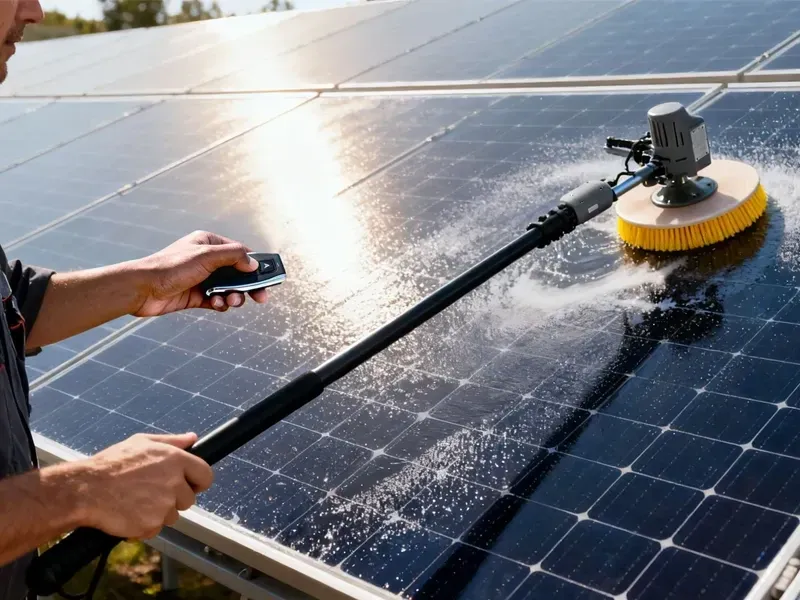
How to Start a Solar Panel Cleaning Business: Equipment, Contract Models and the Numbers That Decide It
How to start a solar panel cleaning business: starter equipment, contract models, payback arithmetic and the cleaning conditions module makers set.

The short answer
In our reading, a solar panel cleaning business earns its money from repeat work, and three numbers decide whether it works: what one visit costs you to deliver, how many visits a year each customer buys, and how fast the equipment pays back. Solar Energy Simplified (SES) publishes average prices of $225 for one cleaning and $375 a year for a two-visit contract, which is 67% more revenue per customer-year at a 17% lower price per visit. SES and Helios both put the contract discount at 10–20%. Our calculation shows that a discount of that size keeps a contract customer at least as profitable as a one-off customer while one visit’s variable cost stays below roughly 60% (for 20% off) to 80% (for 10% off) of the one-off price, for a two-visit contract. Each $10,000 of equipment needs about $1,233 to $3,497 a year of net contribution to be recovered in 10 to 3 years at a 5% discount rate. The part newcomers tend to skip is compliance: module makers set their own cleaning conditions, the conditions differ, and at least one maker recommends avoiding rotating brushes.
Section 1 covers who you sell to, Section 2 the starter equipment, Section 3 water, Section 4 payback arithmetic, Section 5 contract models, Section 6 using data to sell, Sections 7 and 8 the module-maker conditions and the safety rules, Section 9 common pitfalls and Section 10 a checklist.
Scope and disclosure. This article is for someone deciding whether to start a cleaning company and what to buy. We make cleaning equipment: the G-series brushes, the R-series robots, the A40 RO water system and the A60 PV dust measuring instrument. Where our products appear, we quote only what their product pages state (fetched 28 October 2026). Those pages publish no prices and no cleaning productivity in m² per hour, so this article gives none. Customer-side prices are in How Much Does Solar Panel Cleaning Cost?, robot payback in Are Solar Panel Cleaning Robots Worth It?, cleaning frequency in How Often Should You Clean Solar Panels?, water in Can You Clean Solar Panels With Tap Water?, dry against wet in Dry vs Wet Solar Panel Cleaning, and measurement in How to Measure Solar Panel Soiling Loss.
1. Choose the customer segment first: it sets the equipment, the pricing unit and the contract
The same skill is sold in three different ways, and the segment you pick decides almost everything that follows.
- Homes and small rooftops. Our G1 and G2 product pages recommend their equipment for projects of approximately 100–500 m². Jobs are priced per visit; SES’s average is $225 for one cleaning. This is the segment with published contract evidence (Section 5), and the cost article reports that prices rise with roof height and pitch.
- Commercial rooftops. The G3, G3U and G4 pages recommend approximately 500–6,000 m² projects, and the G4 page adds a safe operator access route. Our cost article reports larger jobs priced per panel and converts the figures to a per-kWp price. We found no published contract terms for commercial roofs, so everything in Section 5 that rests on a published figure is a home-scale figure.
- Ground-mounted and utility arrays. The R1 and R2 pages describe crawler robots for compatible commercial or ground-mounted arrays with working angles up to 20°. The price per kWp is far lower than for homes, and in our reading you compete with in-house crews and with large O&M contractors. The cost article works through the equipment budget an owner can justify against a contractor’s price, and the robot payback article works through the robot case.
Our solution page lists a fourth route, automated row cleaning. The R20 robot cleans compatible fixed rows and the R20A shuttle moves compatible robots between rows. The R20A page says to specify it as part of an integrated cleaning-and-transfer project, not as a standalone cleaner, so it is a project purchase rather than a way to start a mobile cleaning business.
2. Starter equipment: three groups, and what the product pages do and do not say
Table 1 groups the equipment we make by how it is carried and operated, using only what the product pages publish. The pages give a recommended project size and the machine’s own specifications. They do not give a price or an area cleaned per hour, and the G4 page’s FAQ says so directly: “Actual productivity depends on layout and access.” Treat the project sizes as a guide to which machine suits which job, not as a measure of how long a visit takes.
| Group | Models | Published on the product pages | Not published |
|---|---|---|---|
| Hand-held and pole-mounted, for small roofs | G1, G2U | G1: unpowered water-fed brush, PBT bristles on a 32 × 7 cm board, aluminium poles 3.6–10.8 m or carbon-fibre poles 3.2–11.2 m, optional 6.0 LPM pump; the page says “No powered rotating brush”. G2U: 45 cm disc brush at 260 RPM, 8–10 h battery runtime, 12.8 kg excluding battery, water cleaning, maximum flow 4 L/min. Both: approximately 100–500 m² projects. | Price; area cleaned per hour; time per visit |
| Wider heads and roller, for commercial roofs | G3, G3U, G4 | G3: 70 cm double head, wireless water-and-power switching, 5–6 h, 14.8 kg excluding battery. G3U: up to 95 cm, wired control, brush-head adjustment up to 30°, same runtime and weight. G4: 60 cm roller brush, wet or dry, IP68, 4–5 h, 12.8 kg excluding battery. All three list a 260 RPM brush speed, 4 L/min maximum water flow and a 3.5, 5.5 or 7.5 m telescopic pole, and all three: approximately 500–6,000 m² projects. | Price; area per hour; crew size |
| Crawler robots, for ground and large commercial arrays | R1, R2 | R1: battery powered, 1,100 or 1,500 mm cleaning width, 20 m/min, working angle up to 20°, maximum crossing span 20 cm, 6–8 h, 48.3 kg including battery, 150–200 m remote range. R2: direct site power at 100–250 V, unlimited runtime, span up to 25 cm, 40 kg, 150 m remote range. Both: wet or dry, 1.84 L/min. | Price; area per hour; how many robots one crew can run. The R2 page’s FAQ says the operating plan must include safe cable routing across the cleaning area. |
Three points follow from the table, and they are our reading. First, the project-size bands meet at 500 m², so the choice between a single head and a wider one is a matter of access and how often you will clean the same array. Second, a robot only works where the array geometry fits its published limits (angle, gap span, frame shape, height differences), and both robot pages say the array must be reviewed before operation. Third, the productivity figures that exist are not ours and have no stated basis. Our cost article reports one company quoted by Thumbtack taking about 1.5–2 hours for up to 32 home panels (crew size not stated), which is at most 16–21 panels an hour. Sellers of cleaning equipment publish higher figures for pole systems: EquipMaxx, a retailer, lists 20–40 panels per hour for a water-fed pole against 5–10 for bucket and brush, and Clean World Brush, a maker of manual brush tools, says an experienced two-person crew can clean roughly 20–40 panels per hour with telescopic poles, depending on roof access. Neither states a sample or test conditions, so treat the range as something to test in a trial, not as a plan.
3. Water, power and the rest of the kit
The machine is the smaller part of the shopping list. A pole brush needs a water supply of suitable quality, a way to carry it, power for the brush, a vehicle and fall protection. Water decides whether a clean looks clean: dissolved solids dry on the glass as spots and films. Our tap-water article sets out the TDS thresholds, and Section 7 shows that module makers set their own limits. First Solar’s guide requires total dissolved solids below 1,500 mg/L, and Trina’s manual asks for 1,000 mg/L or less and a hardness of 0–40 mg/L (calcium plus magnesium).
If your source water is above those limits, you need treatment on the van. Our A40 RO water filtration system comes as the A40-300 and A40-500, producing 300 and 500 L/h and weighing 50 and 55 kg (750 W), and it has its own inlet limits: TDS up to 1,000 ppm, turbidity below 10 NTU and pH 6–8. A brush at its published 4 L/min maximum flow draws 240 L/h, so one unit would supply roughly one brush (A40-300) or two (A40-500) running continuously (our arithmetic from the two pages). Size the water system against the number of heads you run at once, and check the feed water against the inlet limits before you buy.
4. The payback arithmetic you can do before you have a quote
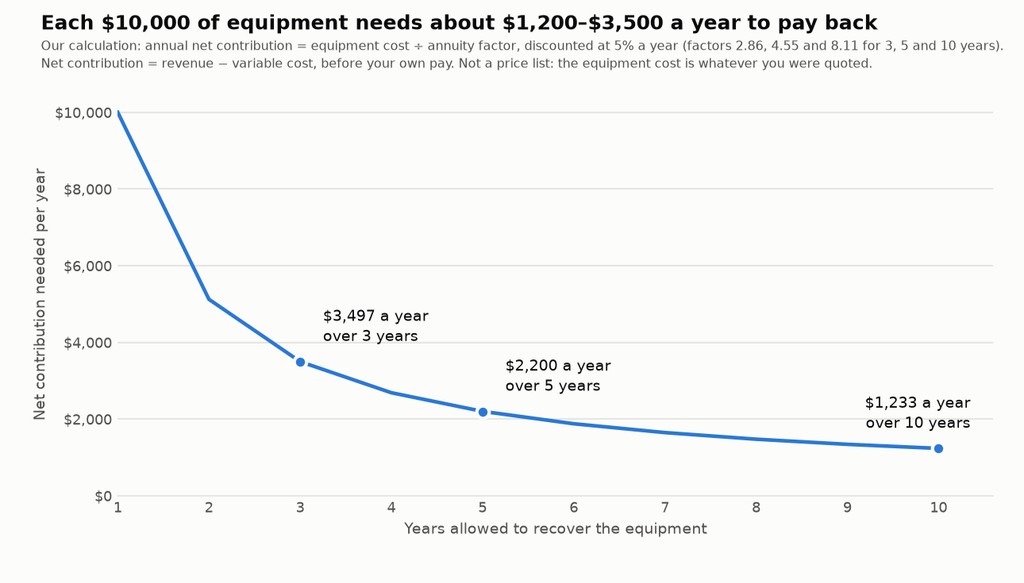
Equipment is recovered from net contribution, which is the revenue from a visit minus the variable cost of delivering it (labour including travel, vehicle, water, consumables). If a kit costs E and you accept an n-year payback with a discount rate r, the net contribution you need each year is E divided by the annuity factor. This is the same 5% discount rate and annuity convention we used in the cost article, where the factor for 10 years is 8.11. For 5 years it is 4.55 and for 3 years 2.86. Per $10,000 of equipment, that is $3,497 a year over 3 years, $2,200 over 5 and $1,233 over 10 (Figure 1). These are our calculations; the equipment price is whatever you are quoted.
To turn that into visits, divide by the net contribution of one visit. Table 2 uses SES’s average single-visit price of $225 and three assumed variable-cost shares. The shares are assumptions to show the sensitivity, not data: the variable cost of a visit is the number you must measure for your own operation.
| Payback horizon | Variable cost 40% of price | Variable cost 60% of price | Variable cost 80% of price |
|---|---|---|---|
| 3 years (needs $3,497 a year) | about 26 visits a year | about 39 visits a year | about 78 visits a year |
| 5 years (needs $2,200 a year) | about 16 visits a year | about 24 visits a year | about 49 visits a year |
| 10 years (needs $1,233 a year) | about 9 visits a year | about 14 visits a year | about 27 visits a year |
Read Table 2 as visits per year for every $10,000 of equipment. At an 80% variable-cost share and a three-year horizon the answer is close to 78 visits a year: when most of the price goes on delivering the visit, little is left to repay a machine. Lowering the variable-cost share (route density, less time on the roof, less travel) moves the answer further than a cheaper machine does. Of our product pages, only the R20A page publishes a service life (25 years for the shuttle), so for the other machines the horizon is your own judgement; ask for it in writing.
What the startup guides say. We found four guides that give a startup total, and they do not agree: $510–1,380 for equipment plus insurance (Opervo), $2,000–5,000 (Self Employed), $7,000–25,000 (JIM) and $18,000–70,000 or more (solarcleanermfg.com). That is a spread of more than a hundredfold. They do not define the same thing, since some include a vehicle and one covers equipment only, and none states how its figure was derived. The retailer EquipMaxx lists $1,500–5,000 for a complete water-fed-pole setup and $15,000–100,000+ for robotic equipment, again without a source. Use these as a reason to ask for quotes, not as a budget.
5. Contract models: who carries which risk
A cleaning job can be priced in several ways. Table 3 shows five, with the risk each places on you and on the customer. The first three are the pricing units we found in the cost article. The last two are about commitment, and the final row is our suggestion rather than something we found priced anywhere.
| Model | How it is priced | Who carries the risk | What the published evidence says |
|---|---|---|---|
| Per visit (one-off) | One price per cleaning | You carry demand and travel risk every time; the customer carries none | SES: $225 average for a professional cleaning |
| Per panel | Price × number of panels | You carry access and difficulty risk; the customer carries job size | The cost article reports $5–20 a panel for homes in published guides, and Soilar’s utility list falling from up to $1.75 a panel at 10 MW to as low as $0.37 at 101–250 MW |
| Per kWp or per MW | Price × capacity | Same as per panel, without dependence on module size | The cost article converts the published figures to roughly $19–34 per kWp per visit for homes and $0.33–4.73 on solar farms |
| Annual or semi-annual contract | A fixed number of visits a year at a lower price per visit | You carry the cost of every scheduled visit whether or not the array needed it; the customer carries the soiling in between | SES: contracts typically save 10–20% against single bookings, a two-visit contract typically runs $250–500 (average $375). Helios: signing up for two or three visits a year often reduces the per-visit cost by 10–20% |
| Trigger-based contract (our suggestion) | A visit when a measured cleanliness reading crosses an agreed threshold | Both sides carry measurement risk, so the measurement has to be agreed and validated first | We found no published prices for this model. Section 6 covers the measurement |
The case for recurring work. SES’s own averages imply that a contract customer brings $375 a year against $225 for a one-off customer, 67% more revenue per customer-year, at a price per visit that is 17% lower. SES does not describe a sample or a method for these averages, so treat them as one guide’s picture, not a measurement. Two further published discounts point to where the cost savings come from. SES says many companies offer 15–25% off when they can clean several homes on the same street in one trip, and says winter months (November to February) are slower, with some off-season discounts of 10–15%. Our reading is that both are funded by lower delivery cost or by work that would otherwise not exist: less travel in one case, filling slack months in the other.
How larger contracts are structured. Industry guidance describes the same building blocks. NREL’s O&M best practices (3rd edition, December 2018) say the cost of cleaning is “usually a fixed fee to mobilize a cleaning crew and then a per-unit-area cost for labor and materials ($/m2)”. SolarPower Europe’s O&M guidelines (version 6.0, February 2025) list module cleaning as “Generally included, or as a priced option” in an O&M contract, with additional services priced per service action or at hourly rates. A Sandia and EPRI study of mainly US utility-scale practice, based on 18 interviews and a 20-respondent survey (December 2015), says tasks such as panel washing can be billed on a time-and-materials basis. We found no published measurement of how much cleaning revenue is recurring, of customer retention or of typical contract length for standalone cleaning contracts, and no published prices for contracts tied to a soiling reading.
How big a discount can you afford? Compare one customer-year under each model. A one-off customer who books once pays price p and costs you variable cost v per visit, so you keep p − v. A contract customer who books k visits at a discount d leaves k(p(1 − d) − v). Setting the second at least equal to the first gives d ≤ (1 − v/p)(1 − 1/k). This is our derivation, and it leaves out the cost of finding the customer, which would favour the contract further. It also assumes the one-off customer would have booked once a year anyway. Table 4 and Figure 2 show the result.
| Visits in the contract | Ceiling at variable cost 40% of price | 60% | 80% | Highest variable-cost share that supports 10% off | Highest that supports 20% off |
|---|---|---|---|---|---|
| 2 a year | 30% | 20% | 10% | 80% | 60% |
| 4 a year | 45% | 30% | 15% | 87% | 73% |
| 12 a year | 55% | 37% | 18% | 89% | 78% |
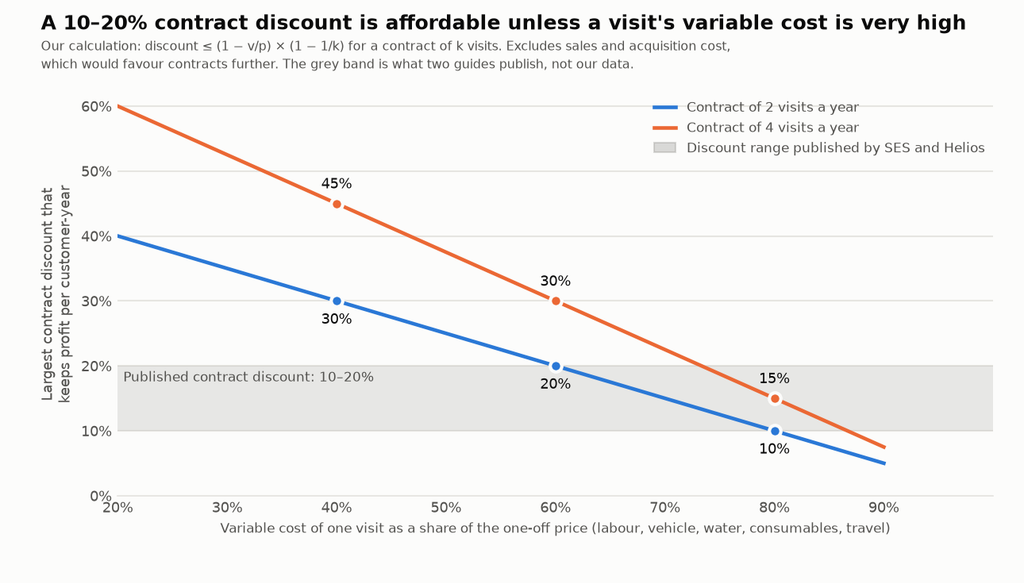
Two readings follow, both ours. The published 10–20% sits inside the ceiling whenever variable cost is below about 60% of the price for a two-visit contract, so a contract at those discounts is not a loss-maker on its own terms. And the ceiling rises with the number of visits but with diminishing effect: going from 2 to 4 visits lifts the 40% case from 30% to 45%, and going on to 12 lifts it only to 55%. The model fails in the case that matters most commercially: if the one-off customer would already have booked k visits a year, a contract discount is a straight price cut and the contract earns its place only through retention.
6. Selling with data: what a dust reading can and cannot show a customer
A cleaning customer buys an outcome they cannot see: more energy, or less risk. Two kinds of evidence are available, and they answer different questions.
- A glass-cleanliness record. An optical sensor on site logs how dirty its own piece of glass is. Our A60 PV dust measuring instrument is one. Its product page says to use it “to monitor optical PV-glass cleanliness, not to directly measure energy loss”, and its FAQ adds that energy impact also depends on irradiance, module behaviour and system conditions. A time-stamped trend, with readings before and after each visit, is useful for scheduling and for showing the customer that visits happened. It does not prove a number of kWh.
- Energy evidence. A power-based before-and-after test on a sample string or module measures the effect on output. It is one moment in time, and irradiance and temperature move between the two measurements. Our measurement article compares the methods, and IEA PVPS Task 13 estimates the uncertainty of optical methods at 4–7% against 1–2% for power measured in a cell-module or module-module configuration (IEA stresses these are estimates).
So the practical position, which is our reading, is to sell the record and be honest about what it is, and to offer a power-based test where the customer wants a kWh figure. Do not write an energy gain into a contract that you cannot measure. A trigger-based contract is worth offering only after the sensor reading has been checked against power on that customer’s array, because a reading taken after rain is a statement about the sensor’s own glass until you have validated it (our rain article covers what rain leaves behind).
7. Module makers set their own cleaning conditions, and they differ
This is the part of the business plan that is easiest to miss, because it comes from the modules and not from the market. We read the cleaning section of each of four makers’ manuals (28 October 2026). Table 5 sets out what they say about tools, pressure and water.
| Maker and document | Tools and brushes | Water pressure | Water quality | Other conditions |
|---|---|---|---|---|
| First Solar, Series 6 Plus User Guide, rev 2.5, section 8.2 | Preferred order, as a recommendation: wet non-contact, then soft mops or cloths, then soft brushes. Brush load at most 0.18 kg per cm of contact; total load while cleaning at most 40.8 kg per module, evenly distributed | Below 35 bar at the nozzle | TDS below 1,500 mg/L; RO water recommended, otherwise tap water with total hardness below 75 mg/L | Water within 20 °C of module temperature; open circuit; trained personnel with insulating PPE. The cover carries the line “Not intended for residential use in USA or rooftop applications, including commercial and industrial” |
| Trina Solar, Vertex user manual, Ver C, 20 January 2021, section 9.3 | “Use dry or wet soft clean cloth”; “non-corrosive solvents or hard objects are strictly prohibited”. The section mentions cloths and does not mention machine brushes (our reading) | Not above 700 kPa on the glass (about 7 bar) | pH 5–7; TDS 1,000 mg/L or less; hardness 0–40 mg/L; turbidity 0–30 NTU | Irradiance below 200 W/m²; no steam cleaner; no cleaning in heavy rain, heavy snow or wind above grade 4; a cleaning record is required |
| Canadian Solar, installation manual EN-Rev IM/GN-AM-EN/2.2, July 2020, Annex D | “Canadian Solar Inc. recommends to avoid rotating brush cleaning methods, as they could create micro-cracks in the PV modules.” Compressed air for soft dirt; a non-conductive, non-abrasive brush or sponge “with caution” for heavy soiling; “Do not use abrasive or electric cleaners on the module” (the guide does not define “electric”) | Maximum recommended 4 MPa (40 bar) | Water with low mineral content and near-neutral pH | Damage from inappropriate cleaning procedures “will void Canadian Solar Inc. warranty”; avoid the hottest hours |
| JA Solar, Cleaning Method of JA Solar Modules’ Glass, Portuguese edition, file dated 10 October 2022 | Soft foam, non-woven cloth, soft sponges and soft brushes allowed; for anti-reflection glass the bristle is nylon 1010, 0.06–0.1 mm; no metal tools | Below 690 kPa (100 psi) | High-mineral water not recommended | Do not step, stand or sit on modules; no steam or corrosive chemicals (our translation) |
Three conclusions, all ours. First, no single method satisfies all four. The pressure limits alone run from 690 kPa to 4 MPa, a factor of almost six, and may not be measured at the same point: First Solar says at the nozzle and Trina says on the glass. Second, rotating brushes are the contested method. Canadian Solar recommends avoiding them, JA specifies the bristle for brush use, and First Solar lists soft brushes last in its order of preference. That applies to our own range: the G2U, G3, G3U and G4 pages publish a 260 RPM brush speed, and only the G1 page says it has no powered rotating brush. We have not tested our machines against any maker’s conditions, and nothing here claims that they meet them. Third, the conditions are a contract matter. Ask for the module model and its manual before you quote, write the permitted method, pressure and water quality into the scope of work, and keep the job record. First Solar’s guide states that it “does not warrant against breakage, damage, wear, or module performance issues that are determined to be caused by module cleaning”, and Canadian Solar’s says improper cleaning voids its warranty, so a cleaning company that ignores them is carrying a risk the customer may not know about.
SolarPower Europe’s O&M guidelines give asset owners a similar checklist for choosing a cleaning company: the method should be fully in line with the module manufacturer’s warranty; the water should be “high quality, ultra-pure water, not tap, mains or borehole water”, which is stricter than First Solar (it recommends low-mineral tap water where RO is not available) and Trina (numeric limits); detergents should be biodegradable; and staff should have health-and-safety accreditation and specific training, including working at height for roof-mounted modules. It is a ready-made list of questions to answer in a bid.
A related check concerns weight. First Solar’s limit is 40.8 kg per module, spread evenly, and its point-load rule allows 13.6 kg per contact point spaced 40.6 cm apart. Our R1 page publishes 48.3 kg including battery and the R2 page 40 kg. The two figures are not directly comparable: the manual limits the load on each module, which depends on how a machine’s weight is shared among the modules and supports it rests on at any moment. We have not made that comparison for any maker, so ask the maker before putting a machine on its modules.
8. Work at height and electrical risk
Cleaning is often work at height, and in daylight it is work on live electrical equipment. The primary texts are short, and the wording matters.
- United States, general industry. 29 CFR 1910.28(b)(1)(i) requires protection from falls at unprotected sides and edges 4 feet (1.2 m) or more above a lower level, by guardrails, safety nets or personal fall protection.
- United States, construction. 29 CFR 1926.501(b)(1) sets the trigger at 6 feet (1.8 m), and paragraphs (b)(10) and (b)(11) deal with low-slope and steep roofs. Whether a given cleaning job falls under general industry or construction is a question for OSHA or a safety professional; we did not verify any OSHA guidance on solar cleaning specifically. We read both texts as reproduced by Cornell Law School’s Legal Information Institute because osha.gov was not reachable from our environment, so check the current eCFR before relying on them.
- United Kingdom. Regulation 6(2) of the Work at Height Regulations 2005 says: “Every employer shall ensure that work is not carried out at height where it is reasonably practicable to carry out the work safely otherwise than at height.” Whether a pole used from the ground meets that test on a particular roof is a risk-assessment question.
On electrical risk, two of the manuals use nearly identical warnings. First Solar’s guide says “The voltage and current present in an array during daylight hours are sufficient to cause a lethal electrical shock” and that cracked or broken modules are a shock hazard, with the risk higher when they are wet. It asks for trained personnel in insulating PPE and for cleaning in open circuit, and it notes that professional cleaning services trained to work on live electrical systems are available for hire. Canadian Solar says to inspect for cracks, damage and loose connections first and to disconnect the array before starting. Inspection before cleaning, disconnection and training are therefore part of the service you sell, and they are also a cost in the variable cost of every visit.
9. Pitfalls that sink new cleaning companies
These come from the sources above and from the arithmetic, not from a survey of failed businesses, which we did not find.
- Water that leaves residue. Without checking the feed water, a clean can leave spots. The makers set limits (Section 7), and an RO unit has its own inlet limits (Section 3).
- Promising energy numbers you cannot measure. A glass-cleanliness reading is not a kWh figure (Section 6), and the A60 page says as much about itself.
- A crew sized for the busy months. SES reports a slower winter (November to February) and some 10–15% off-season discounts. Soiling is seasonal where rain is: at one 1 MW plant in southern Spain, Micheli et al. (2021) found that 97% of the year’s soiling losses fell in the long summer dry period (one site, one year), and NREL’s guidelines suggest scheduling around the end of pollen season. If you hire for the peak, the lean months carry the same labour cost, which pushes the variable-cost share up and the payback longer (Table 2).
- A book made only of one-off jobs. In our reading, revenue resets each season and every customer has to be won again. Published averages put a contract customer at 67% more revenue a year (Section 5), and Table 4 shows how large a discount that revenue can fund.
- Quoting before you have seen the roof. The G4 page says productivity depends on layout and access, and the robot pages say gap, height difference and frame shape must be reviewed. Survey first, or price the survey.
- Method outside the module maker’s conditions. A module failure after cleaning can bring the maker’s clause to the customer and the question to you. Whether you are liable depends on your contract and local law, which we have not reviewed.
10. Checklist before you buy equipment or sign the first customer
- Pick a segment and write down its pricing unit (per visit, per panel, per kWp) and who competes for it.
- For each machine, get in writing the price, the area it cleans per hour on an array like your customers’, its weight, and the cleaning method it uses. Our product pages do not publish the first two, so ask.
- Measure the variable cost of one visit honestly: hours including travel and set-up, vehicle, water, consumables, PPE. Divide by your price to get the variable-cost share used in Tables 2 and 4.
- Check the payback you need: $2,200 a year per $10,000 over five years (Figure 1), and the visits that implies (Table 2).
- Design a contract ladder (one-off, two visits, four visits) with discounts below the ceiling for your own variable-cost share (Table 4).
- Get the module model and read the maker’s cleaning section before quoting. Put the permitted method, pressure and water quality in the scope of work (Table 5).
- Test the TDS of your water source. If it is above the limits in Section 3, budget for treatment and check its inlet limits.
- Run a work-at-height risk assessment and decide on fall protection and access for each roof type you will accept.
- Inspect modules for cracks before cleaning, work in open circuit where the maker requires it, and train and equip people for electrical risk.
- Ask your insurer and your local authority what cover and licence you need. We did not find an authoritative published figure that applies across countries.
- Decide what evidence you will give each customer: a before-and-after glass-cleanliness record, a power-based test, or both, and write down what each does and does not show.
Frequently asked questions
How much does it cost to start a solar panel cleaning business?
Published guides give totals from $510 to $70,000 or more, a spread of more than a hundredfold, and none states how it was derived; our own product pages list no prices. What you can calculate is the revenue you need: each $10,000 of equipment needs about $3,497, $2,200 or $1,233 a year of net contribution to be recovered over 3, 5 or 10 years at a 5% discount rate (Section 4). Add the vehicle, water, PPE, fall protection, insurance and training, at whatever they cost where you work.
Is a solar panel cleaning business profitable?
It depends on your variable cost per visit and how many visits each customer buys. SES’s published averages are $375 a year for a two-visit contract and $225 for one cleaning, which is 67% more revenue per customer-year, but revenue is not profit. Table 4 shows that a 10–20% contract discount keeps profit per customer-year level with a one-off customer when the variable cost of a visit is below roughly 60% (20% off) to 80% (10% off) of the one-off price, for a two-visit contract.
How many solar panels can one person clean in an hour?
No independent measurement was found. The job time that Thumbtack quotes for one company implies at most 16–21 home panels an hour. Equipment sellers publish 20–40 panels an hour for a water-fed pole and 5–10 for bucket and brush, with no sample or conditions stated. Our product pages publish no productivity; the G4 page says it depends on layout and access.
What equipment do you need to start?
A water source of suitable quality (with treatment if the source is hard), a brush on a pole, a vehicle, personal protective and fall-protection equipment, and a way to record what you did. Smaller roofs suit a single-head or hand-held brush, larger commercial roofs a wider head, and compatible ground arrays a robot. Check the module maker’s cleaning conditions before you choose (Section 7).
Do you need a licence or insurance to clean solar panels?
We did not find one authoritative source that answers this across countries and states. Rules differ by place and by customer, so ask your local authority and an insurer. Two guidance documents say what a customer may expect: NREL’s O&M best practices list, for a cleaner, a 10-hour OSHA card and the “required level of bonding and insurance” (a job specification, not a legal requirement), and SolarPower Europe asks for health-and-safety accreditation and specific training (Section 7). Employers also have work-at-height duties in the United States and the United Kingdom (Section 8), and module makers say their warranty may not cover damage caused by cleaning.
How should I price a solar panel cleaning contract?
Start from your variable cost per visit and keep the discount below the ceiling in Table 4. Published guides put contract discounts at 10–20%, with 15–25% when several homes on one street are cleaned in one trip. Our cost article lists the prices these discounts apply to.
Can brushes damage solar panels?
Module makers disagree. Canadian Solar recommends avoiding rotating brushes because of micro-crack risk, First Solar allows soft brushes with load limits and lists them after non-contact methods and cloths, and JA Solar specifies the bristle diameter. Our dry-versus-wet article covers the scratching risk of dry brushing. The safe course is to follow the maker’s manual for the modules in front of you.
How do you prove a cleaning worked?
Two ways. A glass-cleanliness reading before and after the visit shows the glass was cleaner; the A60 page says it is for monitoring cleanliness and not for directly measuring energy loss. A power-based before-and-after test on a sample string measures the effect on output, with its own limits (measurement article).
Should I start with a robot or a manual brush?
For a new business with homes or small commercial roofs, a robot only fits arrays within its published limits (angle up to 20°, gap span 20–25 cm), and neither the manual brush nor the robot has a published productivity. Work out the payback you need first (Section 4). Our robot article covers the payback case for plant owners.
Sources
- Solar Energy Simplified — Solar Panel Cleaning Cost in 2026 (28 March 2026) (single-visit and two-visit contract averages, contract and street-group discounts, winter slowdown; no sample or method stated)
- Helios Energy Global — Solar Panel Cleaning Cost 2026 (updated 1 September 2026) (repeat-visit discount)
- Thumbtack — How much does it cost to clean solar panels? (updated 31 March 2026) (one company’s job time for up to 32 panels)
- WaterSprayElephant — How Much Does Solar Panel Cleaning Cost? (price units, per-panel and per-kWp conversions, Soilar utility list, 5% annuity convention)
- First Solar — Series 6 Plus and Series 6 Plus Bifacial User Guide, MPD-00895-06-G REV 2.5 (section 8.2, module cleaning; load, pressure and water-quality requirements; warranty statement; cover scope note)
- Trina Solar — Vertex User Manual (Back Sheet-Glass Framed), PS-M-0906 Ver C, 20 January 2021 (section 9.3; copy hosted by a Swiss distributor, because Trina’s own static URLs returned 404 on 28 October 2026)
- Canadian Solar — Installation Manual of Standard Solar Modules, EN-Rev IM/GN-AM-EN/2.2 (July 2020) (Annex D, module cleaning guideline)
- JA Solar — Manual de Limpeza / Cleaning Method of JA Solar Modules’ Glass (Portuguese edition hosted by a Brazilian installer; the English file on jasolarbrasil.com.br was not retrievable; our translation)
- 29 CFR 1910.28 — Duty to have fall protection and falling object protection (via Cornell LII; paragraph (b)(1)(i))
- 29 CFR 1926.501 — Duty to have fall protection (via Cornell LII; paragraphs (b)(1), (b)(10), (b)(11))
- UK Work at Height Regulations 2005 (SI 2005/735), regulation 6 (legislation.gov.uk)
- IEA PVPS Task 13 — Soiling Losses: Impact on the Performance of Photovoltaic Power Plants (T13-21:2022) (uncertainty estimates by measurement method)
- NREL, Sandia, SunSpec Alliance and SuNLaMP Working Group — Best Practices for Operation and Maintenance of Photovoltaic and Energy Storage Systems, 3rd Edition (December 2018) (cleaning cost structure, seasonal cleaning triggers, cleaner role requirements; read from the SunSpec-hosted copy)
- SolarPower Europe — Operation & Maintenance Best Practice Guidelines, Version 6.0 (February 2025) (additional services and module cleaning; checklist for choosing a cleaning company; read from a third-party copy of the PDF, as the official page offers a download form)
- Sandia National Laboratories and EPRI — Budgeting for Solar PV Plant Operations & Maintenance: Practices and Pricing, SAND2015-10851R (December 2015) (time-and-materials billing of panel washing; 18 interviews and a 20-respondent survey, mainly US utility-scale)
- Micheli, Fernández, Aguilera and Almonacid — Economics of seasonal photovoltaic soiling and cleaning optimization scenarios, Energy 215 (2021), 119018 (seasonality of soiling at one 1 MW plant in southern Spain; read from the accepted manuscript)
- Startup-cost guides, fetched 28 October 2026: Opervo, Self Employed (updated 10 April 2026), JIM and solarcleanermfg.com; none states a method
- Equipment-seller productivity and price figures, fetched 28 October 2026: EquipMaxx — Solar Panel Cleaning Equipment Guide 2026 and Clean World Brush — Solar Panel Cleaning Brush vs Robot; neither states a sample or test conditions
- WaterSprayElephant product pages, fetched 28 October 2026: G1, G2U, G3, G3U, G4, R1, R2, R20, R20A, A40, A60 and the solution page (published specifications, project-fit statements and FAQs; no prices or productivity are published)