PV cleaning equipment manufacturer
PV cleaning equipment manufacturer

How Do You Remove Ice and Frost From Solar Panels Safely? What 12 Manuals and Research Say
How to remove ice and frost from solar panels safely? Three of 12 maker manuals say not to remove frozen snow or ice; none names a de-icer.

The short answer
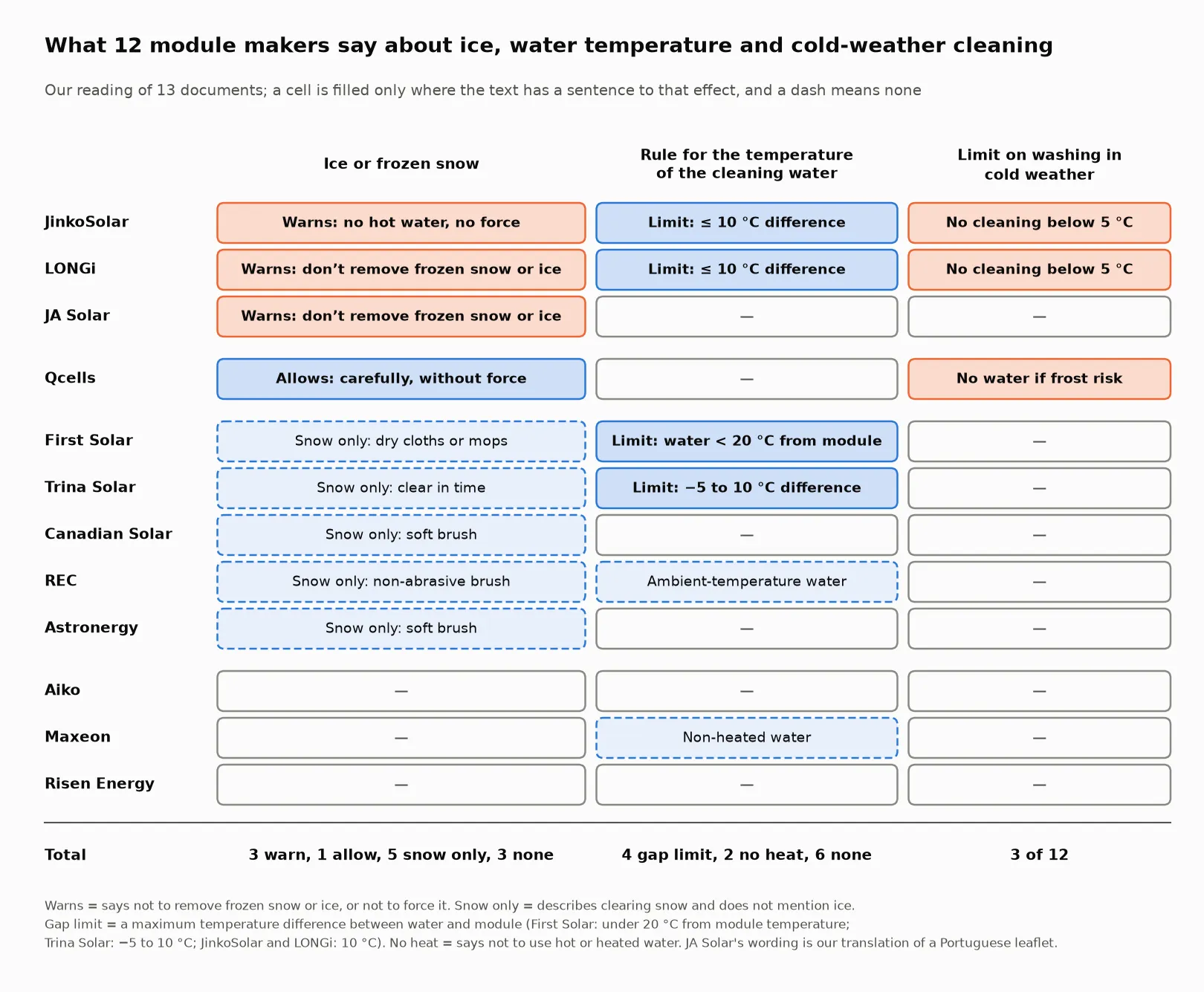
Our reading: the manuals say far more about what not to do to ice than about how to remove it, and the most any of them offers for ice already on the glass is Qcells’ instruction to remove snow and ice “carefully without force”. Of the 12 makers whose manuals we read (13 documents), three warn against removing frozen snow or ice, or against forcing it (JinkoSolar, LONGi and JA Solar), one allows removing snow and ice gently (Qcells), five describe how to clear snow but do not mention ice (First Solar, Trina Solar, Canadian Solar, REC and Astronergy) and three have no snow-clearing instruction at all (Aiko, Maxeon and Risen Energy). Not one of the 13 documents names a de-icer, an antifreeze or an ice-melt product.
Three things decide what you can do. The need: Sandia’s analysis of inverter data puts a highly transmissive layer of frost or snow in a mode where little to no power is lost, and the US Department of Energy says removing accumulated snow or ice is not recommended. The water: four makers (JinkoSolar, LONGi, REC and Maxeon) say not to use hot or heated water, four give a limit for the gap between water and module (First Solar, Trina Solar, JinkoSolar and LONGi), and three (JinkoSolar, LONGi and Qcells) say not to wash in near-freezing conditions. The force and the chemicals: the manuals that mention scrapers, blades or destructive tools ban them, and three (Qcells, Trina Solar and Maxeon) tie damage from cleaning to the warranty.
The practical rule, in our judgement: treat bonded ice as something to wait out, not something to wash or scrape off. If your maker’s text is silent, ask the maker or your installer in writing before you use hot water, salt, a de-icer or any tool that is not soft. Section 8 is a checklist. This is not advice to climb onto an icy roof or an icy array.
Scope and disclosure. This article is about removing ice and frost from the glass and about cleaning in cold weather. Water temperature on hot panels, pressure and bristles are in Can You Pressure Wash or Brush Solar Panels?, water quality in Can You Clean Solar Panels With Tap Water?, ground-level work and overhead lines in Can You Clean Solar Panels With a Water-Fed Pole?, and how often to clean in How Often Should You Clean Solar Panels? Snow loads, ice dams on roofs and snow-shedding design are outside this article. WaterSprayElephant makes PV cleaning equipment, so we have an interest in this question; the last part of Section 8 lists the cleaning modes our product pages describe. We have not tested any product of ours on ice, on frost or in freezing weather, and nothing here says that any product of ours is suitable for them.
1. What the 12 manuals say about ice and frost
Figure 1 sorts the 12 makers on three questions: what the manual says about ice or frozen snow, whether it gives a rule for the temperature of the cleaning water, and whether it limits washing in cold weather. The sort is ours: a cell is filled only where the manual has a sentence to that effect, and Tables 1 and 2 give the sentences. A dash means the manual has no instruction on that point.
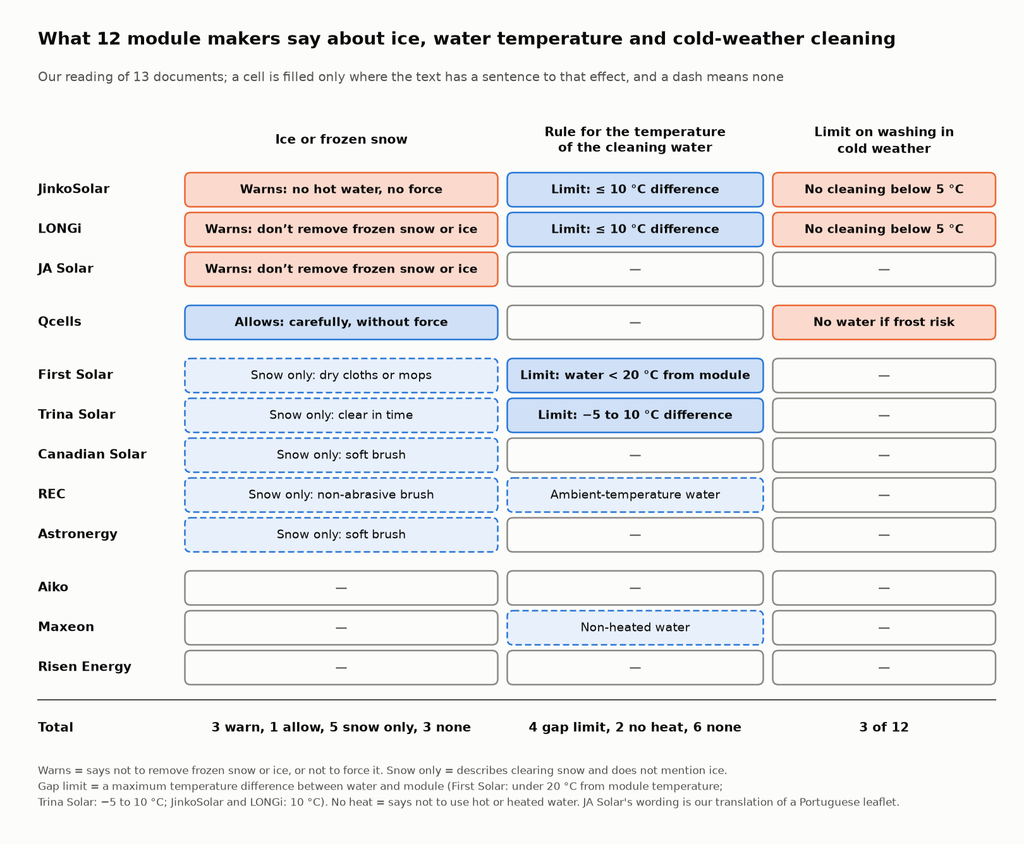
Table 1. Wording on ice, frozen snow and frost, for the four makers that say anything about it. Quotation marks mean the words are verbatim. ‘What it leaves open’ is our reading.
| Maker | What the text says | What it leaves open |
|---|---|---|
| JinkoSolar – Cleaning Manual v1.0, section 8, Method C | “it is strictly prohibited to use hot water to melt snow or ice on the module surface, as it may cause a thermal shock and possible glass breakage”. “The use of forceful methods or destructive tools to remove snow or ice that is frozen on the module surface is also strictly forbidden.” | Names a brush or mop for snow, and gives no method for ice that is already bonded to the glass. |
| LONGi – O&M manual v02, section 2.2.5 | “Please do not try to remove the frozen snow or ice on the module to prevent damage to the surface glass of the module.” “Do not forcibly clean up frost and snow to prevent damage to the surface glass of the module.” | Does not say what to do instead, or how thick a layer counts as ‘frozen’. |
| JA Solar – cleaning leaflet, section 5 (Portuguese) | By our translation, the leaflet’s snow section says to use a cleaning brush to remove the snow gently and use air to blow the snow off as well, but not to try to remove frozen snow or ice from the modules. | One sentence, and no reason given. |
| Qcells – installation manual rev 11, section 8 | “Remove snow and ice carefully without force (e.g. with a very soft broom).” “Do not scratch off dirt.” | Names one tool, a very soft broom, and does not define ‘without force’ or say what to do if the ice does not come off. The second sentence is about dirt. |
JinkoSolar and LONGi use near-identical sentences in several places (Table 2 shows two of them). In our reading that points to a common source or copying, and we cannot tell which came first.
Why clearing snow early and not forcing frozen snow fit together
The manuals can look contradictory. JinkoSolar says “If snow accumulates on Jinko modules, it is recommended to remove the snow as soon as the snowfall has stopped.” In its snow method it adds that “snow can affect the module’s power generation performance and may cause ice formation on the surface”. Trina Solar’s maintenance section says that after snow has built up across the module surface, “such accumulation must be cleared in time, to avoid partial shadow and hot spots caused by the snow melting process”. Yet JinkoSolar forbids hot water and forceful methods for snow or ice that is frozen on the module, and LONGi and JA Solar say not to try to remove frozen snow or ice. In our reading these fit together: loose snow is something to clear early with soft tools, before it can melt and refreeze, and snow or ice that is already frozen on the module is not something to force off.
RISE, a Swedish research institute, summarises earlier work on how snow stays on modules: “Ice adhesion to modules requires some source of moisture; this could be melting snow, freezing rain or condensation.” It adds: “This forms a thin layer of ice or frost with a much larger coefficient of friction than the module surface by itself, making it possible for snow to accumulate”. The RISE paper’s own study is about snow shadowing and module tilt, not cleaning, so it explains a mechanism and does not tell you how to remove the result.
The eight makers with no instruction for ice
First Solar, Trina Solar, Canadian Solar, REC and Astronergy describe snow clearing. First Solar says: “Varying snow conditions may be cleared from the modules when using dry cloths or mops.” “Other snow clearing methods, such as blowers, may be used depending on snow conditions and if approved by First Solar.” Canadian Solar says “Snow should be removed using a soft brush.” Astronergy says “For snow removal, the PV module surface can be cleaned with a brush with soft bristles.” REC says “If required, snow can be brushed or wiped from the panels in the same way as described for cleaning (i.e., with a non-abrasive brush).” First Solar’s only mention of ice is in a loads instruction: if snow loads are expected to exceed design, it says to clear snow so that “ice/thaw/freeze cycles under snow drifts do not result in excessive stresses on the module”. Aiko, Maxeon and Risen Energy have no snow-clearing instruction, and Aiko and Risen Energy forbid cleaning in heavy snow; so do Trina Solar and LONGi (four makers in all). We read the silence on ice as a gap, not as permission.
2. Do you need to remove frost and ice at all?
Sandia is the one source we found that measured anything about frost, and the guidance bodies lean the same way for snow and ice generally. Sandia National Laboratories analysed inverter data from a low-tilt utility-scale site with heavy snowfall, plus two module-scale research systems, and sorted the data into four snow-related loss modes. It says: “Mode 4 was observed to correspond to snow-free production or partial or full coverage by a highly transmissive layer of frost or snow, where in either case, little to no power is lost.” It adds that “some power losses were observed in Mode 4 – these may be attributable to fog or dew – but they were small relative to the frequency of Mode 4.”
That is a useful result and a narrow one. The paper lumps frost together with highly transmissive snow, gives no thickness at which a layer stops being transmissive, and is about snow losses, not about cleaning. REC’s quick guide says that as snowfall generally occurs at times of the year when irradiation is at its lowest, “clearing snow build-up from the panels is not essential for maximum performance”. NREL’s operations and maintenance guide says “Snow is rarely removed from PV systems because it is not cost effective and damage may occur to the PV modules and wiring.” The US Department of Energy’s winter-weather page says “Removal of accumulated snow or ice is not recommended” and adds “if attempted, it should be done with extreme caution and care.” It also says “Most snow will melt quickly off PV systems or be blown off by wind”.
The other side of the argument is partial coverage and structure. LONGi says “the obstruction of dust, bird droppings, ice and snow will reduce the output power, and partial obstruction may even cause hot spots”, and Trina Solar names hot spots from the snow-melting process. The Department of Energy page warns that “the formation of ice upon the surface of a PV system can both add to and significantly redistribute the weight of the system”, which is a structural-loads point about frames and supports, not about frost. Sandia’s project sheet says snow cover on PV systems “can block light and create ice dams”. Of energy losses attributed to ice and snow together it says: “Estimates for such losses range from 1 to 15 percent annually, reaching as high as 90 percent in a month”; the figures come from the studies it cites.
In our reading: a thin, transmissive film of frost is the case Sandia’s data put in the little-to-no-loss mode, and a thick, opaque or partial layer of ice is a different case for which we found no loss measurement separate from snow. No manual says at what thickness or duration ice becomes worth removing, which leaves the decision with you and your maker.
3. Hot water and water temperature: the clearest rules in the manuals
Hot water is the clearest no in the documents. JinkoSolar says that for snow or ice on the module, “it is strictly prohibited to use hot water to melt snow or ice on the module surface, as it may cause a thermal shock and possible glass breakage”. LONGi says “Do not use hot water to pour PV modules, as uneven heat and cold will seriously damage PV modules.” REC’s quick guide first warns that cool or lukewarm water on hot panels can crack them, then says: “Inversely, the application of hot or boiling water to cold panels may cause rapid expansion of components and similar breakage.” “Therefore, only water at ambient temperature should be used.” Maxeon’s cleaning clause says to wash the glass with “potable, non-heated water”, and LONGi adds “Do not use steam or corrosive chemical reagents to accelerate cleaning.”
Three of them give a mechanism: thermal shock or rapid expansion (JinkoSolar, REC) and uneven heat and cold (LONGi). None explains why its limit is 10 °C or 20 °C, and none says whether a module covered in ice is treated differently from a bare one.
Table 2. Wording on water temperature and cold-weather washing, for the seven makers that give a rule. Quotation marks mean the words are verbatim. ‘What it leaves open’ is our reading.
| Maker | What the text says | What it leaves open |
|---|---|---|
| First Solar – User Guide REV 2.5, section 8.1 | “Water temperature must be < 20°C from module temperature applied with water pressure < 35 bar (500 psi) at nozzle.” | Does not say which temperature is higher, or whether the rule is meant for frozen modules. Our reading: a limit of 20 °C on the difference. |
| Trina Solar – Vertex manual, section 7.3 | Make sure that “the temperature difference between the water and the module is in the range of” −5 °C to 10 °C. | Does not say which of the two temperatures is subtracted from which. |
| JinkoSolar – Cleaning Manual v1.0, section 6.1 | “The temperature difference between water and module cannot exceed 10°C.” “Do not clean the module when the ambient temperature is lower than 5°C to avoid freezing and cracking of the glass.” | Gives no reason for 10 °C. ‘Ambient’ is air temperature, not module or water temperature. |
| LONGi – O&M manual v02, section 2.2.1 | “The temperature difference between water and module cannot exceed 10°C.” “Do not clean the module when ambient temperature is lower than 5°C to avoid freezing and cracking of the glass.” | Same wording as JinkoSolar’s. |
| REC – quick guide to cleaning | “Inversely, the application of hot or boiling water to cold panels may cause rapid expansion of components and similar breakage.” “Therefore, only water at ambient temperature should be used.” | Does not say what ‘ambient’ means when the air is below freezing. The guide is about routine cleaning, not ice. |
| Maxeon – Rev J, section 6.0 | “To clean a module, wash its glass surface with potable, non-heated water.” | ‘Non-heated’ is not a temperature, and the sentence is about routine cleaning of the glass. |
| Qcells – installation manual rev 11, section 8 | “Do not clean modules with water if there is a risk of frost.” | Does not define ‘a risk of frost’, for example as an air temperature. |
What the numbers mean on a frozen module (our calculation)
Take JinkoSolar’s and LONGi’s limit of 10 °C and read the difference as an absolute value, so the water may be up to 10 °C warmer or colder than the module. Table 3 shows the warmest water that satisfies it. The assumption is ours: the manuals do not say which way the difference runs or whether ‘module’ means glass or cell temperature.
Table 3. Warmest water that meets a 10 °C limit on the difference between water and module (our calculation).
| Module temperature (°C) | Warmest water that meets the limit (°C) |
|---|---|
| 5 | 15 |
| 0 | 10 |
| −5 | 5 |
| −10 | 0 |
| Colder than −10 | None: no liquid water at normal pressure is within the limit |
So on a module at −5 °C, JinkoSolar’s and LONGi’s limit allows water at 5 °C at most, which is a long way from the warm water some online pages suggest. Their separate rule against cleaning when the air is below 5 °C, and Qcells’ rule against using water when there is a risk of frost, point the same way. In our reading, taken together these manuals leave little room for rinsing a frozen module with warm water, and we found no measurement of whether water inside the limit refreezes on the glass, the frame or the roof. A Solar Panel Talk poster in January 2016 put the refreezing concern this way: “Anywhere you spray water, it will run-off short distance and re-freeze, think through any use of water in winter.” That is one person’s view, not a measurement.
4. Scrapers, brooms and blowers: which tools do the manuals allow?
The tools the manuals name for removal are named for snow, apart from Qcells, whose very soft broom is named for snow and ice. In our reading, that is the most important thing to know about tools on ice: for ice that is already bonded to the glass, no manual names a tool.
- Soft brushes and mops for snow. JinkoSolar says “please use tools that will not damage the module surface, such as a brush or mop, to gently clear all snow”. LONGi says “please use tools that will not damage the surface of the module, such as a brush, mop, or blower”. Canadian Solar, Astronergy and REC name a soft or non-abrasive brush, and First Solar names dry cloths or mops.
- Blowers. LONGi lists a blower, and First Solar says other methods such as blowers “may be used depending on snow conditions and if approved by First Solar”. By our translation, JA Solar’s leaflet says to use air to blow the snow off as well. JinkoSolar’s air method (Method B), written for soft dirt such as dust, says “Choose cold air, do not use hot air to clean the module”, while one online page recommends “use an off-grid-friendly air blower set on warm.” (Section 6).
- Scrapers and blades. Maxeon says: “Do not use harsh industrial-strength cleaning materials such as scouring powder, steel wool, scrapers, blades, or other sharp instruments to clean the module glass. Use of such materials will void the product warranty.” JinkoSolar says “the use of forceful methods or destructive tools to remove snow or ice that is frozen on the module surface is also strictly forbidden.” Qcells says “do not scratch off dirt.” (about dirt, not ice).
- What the warranty texts say. Qcells says that “possible damages, caused by the cleaning or related to the cleaning tools or agents shall not be covered by the module’s Product and Performance Warranty”. Trina Solar says “damages caused by failure to clean or improper cleaning procedures will void Trina Solar warranty.” Maxeon is quoted above. These are the makers’ own words and we make no legal reading of them; check the warranty that came with your modules.
The wording about hard tools is the part of this section the manuals agree on. Qcells goes further and lists what wrong cleaning may cause: “Wrong cleaning may cause damages such as, but not limited to, damages to the glass surface (e.g. scratches) and AR coating, power loss, delamination, loss of frame-to-laminate bond, reduced snow and wind load capability etc.” We found no published test of any scraper, broom or blower on ice-covered module glass, so we cannot say how any of them performs.
5. Salt, de-icers and antifreeze: what is written, and what is not
We searched the extracted text of all 13 documents for de-ice and de-icer, antifreeze, glycol, ice melt, rock salt and road salt (and the Portuguese equivalents for the JA Solar leaflet). There were no hits; a term that appears only in an image would be missed. No maker names a de-icer, an antifreeze or an ice-melt product, whether to allow it or to forbid it. The topic is simply absent from the cleaning texts.
What the manuals do say about salt is about corrosion in the environment. Eight of the 12 makers (Trina Solar, Canadian Solar, Qcells, REC, Maxeon, Astronergy, Aiko and Risen Energy) mention salt, salt spray or mist, saline water or brine in installation or environment clauses. Trina Solar says non-offshore modules cannot be used in environments with “strong corrosive substances such as salt, salt mist, saline” and other corrosive substances. Canadian Solar says “exposing modules to salt (i.e. marine environments) or sulfur (i.e. sulfur sources, volcanoes) incurs the risk of module corrosion.” Astronergy lists “strongly corrosive substances (e.g. salt, salt spray, brine, active chemical vapors, acid rain, strong vapor confined environments or any other substance that will corrode PV modules and affect their safety or performance)” as something to consult its technical team about in advance. Qcells says “Contact with saline water (e.g. spray water from the sea) and salt aggregation on the modules must be avoided.” These are written about the surroundings, mainly sea spray, and none mentions de-icing salt. Qcells’ wording, that salt aggregation on the modules must be avoided, is the closest to a direct statement. We read it as a reason to ask before putting any salt on modules, not as a ruling on de-icing salt.
Two manuals add rules about chemicals in general. Canadian Solar says “Do not expose modules and their connectors to any unauthorized chemical substances (e.g. oil, lubricant, pesticide, etc.), as modules may incur damages.” Qcells says: “Do not bring any chemical substance (e.g. oil, solvent etc.) into contact with any part of the panel. Only substances, which are released by Qcells, are allowed to be used during installation, operation and maintenance.” Where manuals do name liquid agents for cleaning, they name them for dirt: LONGi says “detergents, such as commercial glass cleaning agents, alcohol, and methanol, can only be used when the module cannot be cleaned with water.” Qcells says isopropyl alcohol “can be used selectively to remove stubborn dirt and stains within one hour after emergence”. Alcohol appears in the manuals for dirt, not for ice.
The one PV guidance document we read that names ice melters is NREL’s operations and maintenance guide, and it is about roofs. On ice dams it says “Ice dams should be removed to allow the roof to drain properly”, and that “the ice dam can be removed using chemical ice melters or a de-icing cable”. It adds: “Extreme care must be taken not to damage the roof membrane, the PV modules, or connecting wiring.” In our reading that is advice for roof drainage, not a statement that any chemical is suitable for module glass, frames or seals.
What about pets?
One question we saw online (a Quora title; we could not read the answers) asked for a way to clear ice that will not poison dogs. We found no source that tests any de-icing product on module glass, frames or seals, so we cannot say that any product is both pet-safe and module-safe. The ASPCA Animal Poison Control Center has an article on ice melts and pets in general (it does not mention solar panels). It says “Ice melts are commonly made of different kinds of salt.” and “ingesting too much of an ice melt can lead to an elevation in sodium level, causing tremors and seizures.” It also says “pet-friendly ice melts typically contain urea or magnesium chloride.” If a pet may have eaten an ice melt, the article says to contact a veterinarian or the ASPCA Animal Poison Control Center straight away, and gives its phone number.
6. What online advice says, and where it conflicts
We read four web pages and one forum thread. They come from a portable-power maker (EcoFlow), a Yorkshire solar and heating installer (Heat IQ), an online off-grid retailer (Green Vista), a UK solar-cleaning company (Solar Cleaning Southwest) and forum posters. None cites a measurement or a manual clause, so we treat them as opinions.
- No hot water. EcoFlow’s page asks “Is It Safe to Pour Warm Water on Solar Panels to Melt Ice?” and answers: “Pouring hot water on frozen panels can cause thermal shock, which can crack the glass.” It adds that “water will often quickly refreeze in subzero temperatures, making the ice layers on your panels even thicker”.
- Lukewarm for a routine wash, on a mild day. Heat IQ says “Use a soft sponge or cloth with lukewarm water to clean the surface.” and “schedule cleaning on a mild day when temperatures are above freezing to prevent water from freezing on the panels.”
- Warm, not hot, for thin ice. Green Vista says “A gentle spray of warm (not hot) water can help melt thin layers of ice.” and “Use an off-grid-friendly air blower set on warm.”
- No salt or de-icer, or only a solar-specific one. Heat IQ: “Avoid using chemical de-icers or salt, which can erode the panel frames and reduce their lifespan.” Solar Cleaning Southwest: “Household cleaning chemicals, de-icing products or salt solutions should not be applied to solar panels simply to speed up thawing.” Green Vista says “try not to use salt, chemicals, or de-icing sprays not made specifically for solar.”
- Let it melt; do not chip or scrape it. Heat IQ says “if ice does form, allow it to melt naturally rather than attempting to chip it away.” Solar Cleaning Southwest says “metal scrapers, car windscreen scrapers and other hard tools should not be used on solar panels.”
- The forum view. In a January 2016 Solar Panel Talk thread about snow, one poster wrote: “Water is definitely a BAD idea. The water will just refreeze and lead to ice dams.”
They conflict in two places. First, ‘warm’ and ‘lukewarm’ are not temperatures, and the manuals’ ceilings in Table 3 are low. Second, the only page that leaves room for a de-icer does so with ‘not made specifically for solar’, which implies a solar-specific product exists, and we found no maker that names one. Our judgement: where a web page and a maker’s manual disagree, follow the manual, and where the manual is silent, ask the maker.
7. Staying safe around ice and cold water
The bigger risk in a cold snap may be the person, not the glass. Qcells puts a fall warning in its cleaning clause: “Risk of falling due to unsecured access!” “Never access the installation area alone or without taking adequate security precautions.” “Please commission a trade specialist.” Aiko says “Operators must wear a safety helmet, insulated gloves, anti-slip shoes, and other required equipment.” “When working at height, a safety harness must be worn and secured to a fixed anchor point.” The Department of Energy page says “Stepping or standing on panels will cause damage, and crews are often not aware of these risks or may unintentionally put weight on panels.” Solar Cleaning Southwest, a cleaning company, says “Frost can make roof surfaces, ladders, platforms and surrounding ground slippery.” REC adds a warning that is specific to snow: “Beware of snow slippage from higher areas.”
Water adds its own hazard. Heavy snow is a reason not to clean at all for four makers (Trina Solar, LONGi, Aiko and Risen Energy). Water that runs off a module can freeze where it lands: a Solar Panel Talk poster said it will “run-off short distance and re-freeze”, and EcoFlow says water “will often quickly refreeze in subzero temperatures”. If you are working from the ground, overhead lines and non-conductive tools are covered in our water-fed pole article.
We do not give instructions for working at height on ice. First Solar says “Only properly trained personnel who understand the risks of applying water to electrical components should clean modules.” If your array cannot be reached from the ground and the ice is not clearing, the sources point the same way: wait, or hire someone trained for it.
8. What the sources support doing, in order
- Decide whether you need to act at all. Thin, transmissive frost is the case Sandia’s data say loses little to no power; REC says clearing snow is not essential for maximum performance; the Department of Energy says removing snow or ice is not recommended (Section 2).
- Read your maker’s text for ‘ice’, ‘frost’ and ‘temperature difference’. Tables 1 and 2 show the wording differs, and eight of the 12 have no instruction for ice. If yours is silent, ask the maker or your installer in writing.
- Do not use hot water, steam or heated water. Four makers say so outright, and two more (First Solar and Trina Solar) cap the gap between water and module (Section 3).
- Do not wash in near-freezing conditions. JinkoSolar and LONGi say not to clean below 5 °C ambient; Qcells says not to use water if there is a risk of frost (Section 3).
- Do not force or scrape. JinkoSolar, LONGi and JA Solar warn against removing frozen snow or ice or against forcing it, Qcells says without force, and Maxeon bans scrapers and blades (Section 4).
- If clearing snow is part of your plan, do it early with the soft tools your maker names, before the snow melts and refreezes into a bond. This is our reading of JinkoSolar, Trina Solar and the manuals that forbid forcing frozen snow (Section 1).
- Do not put salt, de-icer, antifreeze or alcohol on the modules unless your maker approves it in writing. No manual names any, and Qcells and Canadian Solar restrict unapproved substances (Section 5). This is our judgement.
- Stay off icy roofs and arrays. If you cannot reach the modules from the ground, wait or hire a trained crew (Section 7).
- If in doubt, wait. No manual we read tells you to remove ice from the glass as soon as possible.
What our products offer: dry and water cleaning
WaterSprayElephant makes PV cleaning equipment. We read the pages for our seven models on 16 November 2026. All seven clean with water, and three of them, the G4 roller-brush machine and the R1 and R2 crawler robots, also have a dry mode. What follows is what the pages list.
- G4 roller-brush machine, wet or dry. A portable machine on a telescopic pole of 3.5 m, 5.5 m or 7.5 m, with a 60 cm roller brush and a brushless direct-drive motor, in AC, battery or dual-power versions. The page positions it for projects of approximately 500–6,000 m², and its FAQ says: “Can G4 work without water? Yes. G4 supports wet and dry cleaning configurations.”
- R1 crawler robot, dry or water. A battery-powered crawler robot specified for working angles up to 20°, with a nylon/PBT brush, a wireless remote-control range of 150–200 m and a published runtime of 6–8 hours on dual lithium batteries. Its page lists dry cleaning under ‘Water-limited sites’ and says: “Dry-cleaning capability supports suitable loose-dust conditions after site assessment.” The FAQ adds: “Dry cleaning should be selected only when the dust and module conditions are suitable.”
- R2 crawler robot, wet or dry. A direct-power crawler robot that runs on 100–250 V site power, so the page lists unlimited runtime, with a wireless remote-control range of up to 150 m and the same ‘Dry / water’ cleaning type as the R1. The page says wet or dry cleaning is “available for suitable site and soiling conditions” and that the robot “requires stable 100-250 V site power plus a safe cable-management plan.”
- G1, G2U, G3 and G3U, water cleaning. The G1 is an unpowered water-fed brush with a telescopic reach of up to approximately 11 m. The G2U (45 cm disc brush), G3 (70 cm, double-head) and G3U (up to 95 cm, double-head) are powered machines on 3.5 m, 5.5 m or 7.5 m poles.
Frequently asked questions
How do you remove ice from solar panels safely?
The manuals mostly do not give a method. Three warn against removing frozen snow or ice or against forcing it, Qcells says to remove snow and ice carefully without force (for example with a very soft broom), and hot water, steam, scrapers and blades are ruled out where mentioned. In our reading, the option no manual restricts is to wait. Sections 1 to 4 have the wording.
Can you pour hot water on frozen solar panels?
JinkoSolar says it is strictly prohibited to use hot water to melt snow or ice on the module surface, LONGi says not to use hot water, REC says to use only water at ambient temperature and Maxeon says to use non-heated water. Four makers cap the gap between water and module, at 10 °C for JinkoSolar and LONGi. By our calculation, on a module at −5 °C that allows water at 5 °C at most. See Section 3.
Does frost on solar panels reduce output?
Sandia’s inverter-data analysis puts a highly transmissive layer of frost or snow in a mode where little to no power is lost. LONGi says that obstruction by ice and snow reduces output and that partial obstruction may cause hot spots. We found no measurement that separates frost from snow or gives a thickness, so we cannot say when frost starts to matter. See Section 2.
Can you use salt or de-icer on solar panels?
No manual we read names a de-icer, antifreeze or ice melt, and the makers that restrict chemical substances do so in general terms. NREL names chemical ice melters only for ice dams on roofs. Online pages mostly advise against salt and de-icers, without a test. We found no source that tests any product on module glass, frames or seals, including products sold as pet-safe, so we cannot recommend one. See Section 5.
Can you clean solar panels when it is below freezing?
JinkoSolar and LONGi say not to clean the module when the ambient temperature is lower than 5 °C, to avoid freezing and cracking of the glass, and Qcells says not to clean with water if there is a risk of frost. Most makers do not address it, which we read as a gap, not as permission. See Section 3.
Will ice melt off solar panels by itself?
Heat IQ advises letting ice melt naturally, and RISE, writing about snow, says “the most common cause for passive snow removal is melting and sliding”. We found no measurement of how long a layer of ice stays on a module, so we give no figure.
Sources
- First Solar — Series 6 Plus and Series 6 Plus Bifacial Modules User Guide, MPD-00895-06-G REV 2.5 (10 July 2026), sections 7 and 8.1 (snow clearing, ice/thaw/freeze loads, water temperature limit)
- Trina Solar — Vertex Series user manual, UM-M-0002 Ver. M (February 2025), section 7 (maintenance and cleaning) (copy hosted by a third-party catalogue; temperature difference, snow accumulation, warranty, salt)
- Canadian Solar — Installation manual for PV modules, US-Rev IM/GN-EN/3.3 (July 2026), sections 2 and 8 (soft brush for snow, unauthorised chemicals, salt)
- JinkoSolar — Photovoltaic Modules Cleaning Manual, Version 1.0 (8 October 2024), sections 5, 6 and 8 (distributor copy; hot water on snow or ice, forceful methods, 10 °C and 5 °C limits)
- Aiko — PV Modules Installation Manual, V35 2609 (September 2026), section 9.1 (heavy snow, protective equipment and harness)
- LONGi — PV Module Operation and Maintenance Manual, version 02 (January 2024), sections 2.2.1 and 2.2.5 (frozen snow or ice, hot water, steam, 10 °C and 5 °C limits, detergents)
- Risen Energy — PV module installation and maintenance manual, edition A1[2026], section 12.3 (no cleaning in heavy snow)
- REC — Alpha Pure installation manual, REF PM-IM-23-06 REV 18 (March 2026), IEC edition, ‘Panel maintenance’ (cleaning when cool, salt water) and REC — Quick guide to cleaning (undated) (hot water on cold panels, ambient-temperature water, snow, slippage)
- Maxeon — Safety and installation instructions, Rev J (December 2025), sections 5 and 6.0 (non-heated water, scrapers and blades)
- Qcells — Installation manual, revision 11 (September 2026), sections 2 and 8 (snow and ice without force, frost, warranty, chemical substances, fall warning)
- Astronergy — PV module installation manual, Rev 3.0 (August 2026), sections 3.1 and 7.2 (soft brush for snow, brine; the PDF returned an access error to our download tool in November 2026, so the text is from an earlier retrieval)
- JA Solar — Cleaning method of JA Solar PV modules’ glass, Portuguese edition (2022), section 5 (third-party copy; frozen snow or ice; English wording in this article is our translation)
- Cooper, E. C., Braid, J. L. and Burnham, L. M. Identifying the electrical signature of snow in photovoltaic inverter data. Sandia National Laboratories, SAND2023-14122C. (frost and snow loss modes)
- Sandia National Laboratories, Snow as a Factor in Photovoltaic Performance and Reliability (project sheet for a three-year research project funded by the US DOE, begun 1 October 2018). (ice dams, loss range)
- Granlund, A., Narvesjö, J. and Petersson, A. M. (2019). The influence of module tilt on snow shadowing of frameless bifacial modules. 36th European Photovoltaic Solar Energy Conference and Exhibition (EU PVSEC), RISE Energy Technology Center, Piteå, Sweden. (how ice adheres to modules)
- U.S. Department of Energy FEMP — Solar Photovoltaic Hardening for Resilience – Winter Weather (removal of snow or ice, weight of ice, stepping on panels)
- NREL — Best Practices for Operation and Maintenance of Photovoltaic and Energy Storage Systems, 3rd edition, NREL/TP-7A40-73822 (December 2018), section on snow and ice removal (snow rarely removed, ice dams and chemical ice melters)
- ASPCA Animal Poison Control Center — Keeping Pets Safe during Winter: The Dangers of Ice Melts (4 December 2018) (ice melts and pets in general; not about solar panels)
- EcoFlow — Solar Panel Cleaning in Winter (hot water, refreezing)
- Heat IQ — Solar Panel Maintenance for Winter (19 November 2024; lukewarm water, de-icers and salt)
- Green Vista Living — Ice Formation on Solar Equipment Solutions (online retailer; warm water spray, warm air blower, de-icers)
- Solar Cleaning Southwest — Frost and Solar Panel Cleaning: What to Avoid (UK cleaning company; de-icing products, scrapers, slippery surfaces)
- Solar Panel Talk forum — “Any ideas for removing snow from panels?” (January 2016) (individual posters’ views, not tests)
- WaterSprayElephant product pages retrieved 16 November 2026: G1, G2U, G3, G3U, G4, R1, R2 (cleaning modes, features and, for the R1 and R2, an operating temperature as listed; none of the seven mentions ice, frost, freezing, winter, cold or snow)