PV cleaning equipment manufacturer
PV cleaning equipment manufacturer

Can You Clean Solar Panels From the Ground With a Water-Fed Pole? What the Manuals and Safety Bodies Say
Can you clean solar panels from the ground with a water-fed pole? Only one of 12 makers names a pole; the rest set tool, load and electrical limits.

The short answer
Our reading: yes, in many layouts you can reach and brush a roof or ground array from the ground with a water-fed pole, but no module maker we read sets rules for doing it, and the real hazards are electrical and mechanical rather than cleaning quality. Of the 12 makers whose manuals we read (13 documents), one names an extension pole (REC), and six more set limits that apply to any brush on the end of one: Trina Solar, Canadian Solar and Aiko on non-conductive or insulating tools, JinkoSolar and LONGi on soft nylon bristles, and First Solar on brush load. The other five use none of the words extension pole, telescopic, ladder or long-handle.
Three things decide whether it is a good idea. Reach: by our calculation, a pole that reaches the top edge of the first row on a roof with a 4 m eave needs a straight-line reach of about 4.7 m, and the pole meets the glass at only about 21° to the panel, so most of a push goes along the glass rather than into it. Load: First Solar’s brush limit of 0.18 kg per cm of contact works out to about 5.8 kg for a 32 cm brush lying flat, and we found no published measurement of how hard people press with a pole. Power lines: HSE says “If a machine, scaffold tube, ladder, or even a jet of water touches or gets too close to an overhead wire, then electricity will be conducted to earth.” and J.Racenstein says “Carbon fiber conducts.”
The practical rule, in our judgement: survey for overhead lines before you extend the pole, keep every part of it well clear, use a soft non-conductive head, and treat the force on the glass as something to keep light because nobody has measured it for you. Section 6 is a checklist.
Scope and disclosure. This article is about brushing from the ground with a pole. Water quality is in Can You Clean Solar Panels With Tap Water?, water pressure, bristle types and water temperature across 12 manuals in Can You Pressure Wash or Brush Solar Panels?, and how often to clean in How Often Should You Clean Solar Panels? WaterSprayElephant makes PV cleaning equipment, including a pole-mounted brush, so we have an interest in this question. We have not measured the force of any pole of ours on glass and we do not say that any product of ours meets any maker’s manual.
1. What the manuals say about a brush on a pole
Table 1. Wording from the documents named in Sources that applies to a brush on a pole. Quotation marks mean the words are verbatim. A pole is not named in any of the rows except REC’s, so “applies” here is our reading.
| Maker | What the text says | What it leaves open |
|---|---|---|
| REC – Quick guide to cleaning | For stubborn marks, a soft sponge, microfibre cloth or soft non-abrasive brush: “This may be mounted on an extension pole for an extended reach.” “Care must be taken not to scratch, mark or introduce any foreign elements to the glass surface” Drying: “a rubber squeegee with a plastic frame on an extension pole.” | No pole length, no force, no word on electrical risk. |
| Trina Solar – Vertex manual, Method C | “Please make sure that any brushes or agitating tools are constructed with non-conductive materials to minimize risk of electric shock and that they are not abrasive to the glass or the aluminum frame.” | “Brushes or agitating tools”: it does not say whether the pole counts. |
| Canadian Solar – US edition v3.3, Method B | “Ensure that any brushes or agitating tools are constructed with non-conductive materials to minimize risk of electric shock and that they are not abrasive to the glass or the aluminum frame.” “For cleaning methods using rotating brush, please consult with Canadian Solar’s technical service team in advance.” | Same: the pole is not mentioned. A powered rotating head needs a call to the maker. |
| Aiko – V35 2609 | “Ensure that any brushes or agitating tools are made of insulating material to minimize the risk of electric shock and that they do not scratch the glass or aluminum frame.” | Same. |
| Jinko – Cleaning Manual v1.0 | “Do not use tools or materials that will scratch the surface of modules, such as blades, scouring wire, metal tools, and other abrasive materials.” It also says “brushes with nylon thread that have a diameter of 0.06-0.1mm can be used”. | Says nothing about poles; its 0.5 m rule is for a pressurised nozzle. |
| LONGi – O&M manual v02 | It says “soft brushes and brushes whose diameter of nylon thread is 0.06-0.1mm can be used.” | Nothing about poles. |
| First Solar – User Guide REV 2.5, section 8.2 | “Cleaning solutions, including, but not limited to, manual, robotic or mechanized cleaning systems, vary in design and size and can affect the load dispersed onto the modules.” “Brush load (P3) – maximum of 0.18 kg/cm (1 lbs./inch) of contact length for brushes in contact with the module at any location.” “Uneven loads and pressures must be avoided.” | The limit is per cm of contact, so the number of kilograms depends on the brush; it does not say how to measure force at the end of a pole. |
The other five makers (Risen Energy, Astronergy, JA Solar, Qcells and Maxeon) have their own limits on tools and water, covered in the pressure article, but their texts contain none of the words extension pole, telescopic, ladder or long-handle. Across the 13 documents, REC’s is the only sentence that says a brush may go on a pole, and it gives it as an option, not an instruction.
What the electrical wording does and does not cover
Trina Solar, Canadian Solar and Aiko ask for non-conductive or insulating brushes and tools “to minimize risk of electric shock” (Trina, Canadian Solar) or “to minimize the risk of electric shock” (Aiko). A water-fed pole is a brush head on a long tube, and none of the three says whether the tube is part of the tool. The tube matters, because J.Racenstein, a seller of window-cleaning equipment, writes: “Carbon fiber conducts.” “Carbon poles are not insulated.” In our reading, a non-conductive head does not make the assembly non-conductive, and the manuals cannot tell you whether a carbon-fibre or aluminium pole is acceptable. Ask the maker in writing if the warranty matters to you.
2. Can a pole reach, and at what angle?
This is geometry, so we calculated it. The question is how long a pole has to be to reach the first row of a roof array from the ground, and how steeply it meets the glass. Assumptions are ours: hands 1.5 m above the ground, standing 1.0 m out from the eave line, a 30° roof with panels flat on it, and a first row 2.0 m long along the slope. Change any of them and the numbers move, so treat the table as a way of seeing the shape, not as a specification.
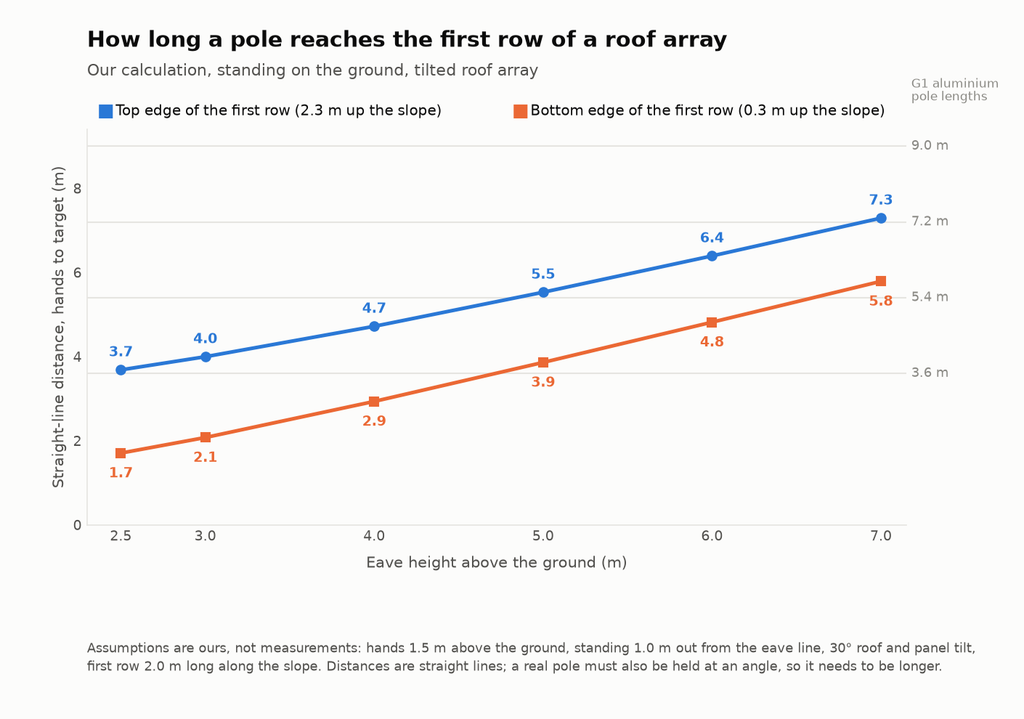
Table 2. Our calculation for the top edge of the first row: how far, how steep, and what share of a push along the pole presses into the glass.
| Eave height | Reach to top edge | Pole angle above horizontal | Angle between pole and glass | Share of a push that presses into the glass |
|---|---|---|---|---|
| 3.0 m | 4.0 m | 42° | 12° | 20% |
| 4.0 m | 4.7 m | 51° | 21° | 35% |
| 5.0 m | 5.5 m | 57° | 27° | 46% |
| 6.0 m | 6.4 m | 62° | 32° | 53% |
The last column is the sine of the angle between the pole and the glass: push with force F along the pole and F×sin(angle) goes into the panel, the rest goes along it. At a 3 m eave that is about 20%, at 6 m about 53%. This is geometry, not a measurement: a pole also flexes and a swivel head changes how the brush lies, so what an operator actually applies can differ. It does explain why a low eave is not necessarily easier: you are pushing almost parallel to the glass, and the head tends to slide up the panel instead of pressing on it.
What window cleaners say about the angle
In a 2016 thread on a hard-to-reach array, one poster wrote: “If your wfp is long enough and you have goose neck attachment and a swivel for your brush I would think you could knock it out from the ground… just an idea.” Another added the condition: “If you have a long enough and stiff enough wf pole with an goose neck and a swivel adaptor for the brush.” The same thread has the verdict of the person who asked: “Definitely not easy.” These are practitioners’ opinions with no measurements, but they agree with the geometry above.
The pole length matters on the operator’s side too. The IWCA water-fed-pole module says “consider using the lightest pole that adequately reaches the top of the window but does not over reach”, and lists among the hazards “Injury through incorrect manual handling of poles and other equipment” and “Adverse Weather- Wind contributing to falling poles” By our arithmetic, the shortest G1 poles listed (3.2 m carbon fibre, 3.6 m aluminium) reach the bottom edge of the first row up to about a 4 m eave (2.9 m needed) but not the top edge from a 3 m eave (4.0 m needed); from a 5 m eave the top edge needs 5.5 m, which is past the 5.4 m pole. We did not calculate ground-mounted arrays; the same geometry applies with the lower edge nearer the ground.
3. How hard can you press? The one load limit we found
Among the 12 makers we found one numeric limit that applies to a manual brush. First Solar’s guide opens its cleaning section by saying “Cleaning solutions, including, but not limited to, manual, robotic or mechanized cleaning systems, vary in design and size and can affect the load dispersed onto the modules.” It then sets “Brush load (P3) – maximum of 0.18 kg/cm (1 lbs./inch) of contact length for brushes in contact with the module at any location.” It adds: “Uneven loads and pressures must be avoided.”
By our calculation, for a brush 32 cm long (the length of the G1’s 32 × 7 cm brush board, per its product page) lying flat, 0.18 kg/cm × 32 cm = 5.76 kg, or about 56 N. If only 10 cm of the brush carries the push, the same 5.76 kg is 0.58 kg/cm, over three times the limit. So the limit is about contact length as much as force, and a pole held at a shallow angle with a head that rocks onto its edge can concentrate the load without feeling heavier.
What we could not find: any published measurement of the force a person applies at the end of a water-fed pole on glass, any maker statement on how to check a pole against its limit, or a test of a pole-mounted brush against First Solar’s number. We are not saying a pole exceeds it, only that nobody has shown that it stays under it. That is why, in our judgement, the advice is to keep it light: let the water do the work, and see the pressure article for what the makers say about scrubbing.
4. Overhead lines and conductive poles
This is the hazard the safety bodies document directly, and it is not specific to solar. The UK Health and Safety Executive says in its overhead-lines guidance: “If a machine, scaffold tube, ladder, or even a jet of water touches or gets too close to an overhead wire, then electricity will be conducted to earth.” It adds that “An overhead wire does not need to be touched to cause serious injury or death as electricity can jump, or arc, across small gaps.” and that you should “always assume that a power line is live unless and until the owner of the line has confirmed that it is dead.”
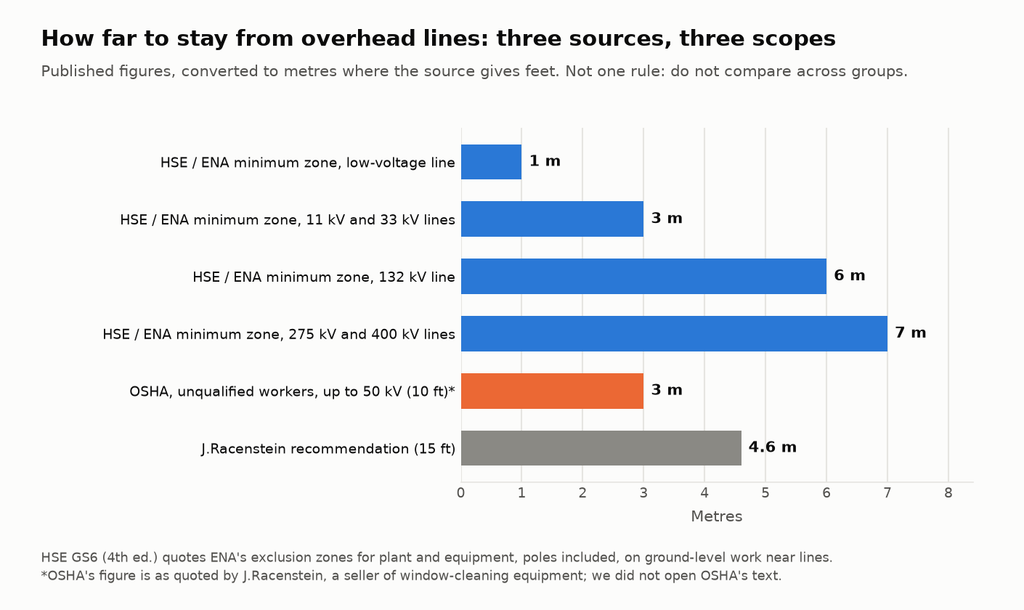
HSE (fourth edition of GS6) lists the minimum extent of exclusion zones by voltage, from 1 m for a low-voltage line to 7 m for 275 kV and 400 kV lines, and says “under no circumstances must any part of plant or equipment such as ladders, poles and hand tools be able to encroach within these zones.” It also says to “Allow for uncertainty in measuring the distances and for the possibility of unexpected movement of the equipment due, for example, to wind conditions” The guide names “window cleaning” among its examples of work near wires connected to buildings: “Examples of such work are window cleaning, external painting or short-term construction work.” “People, plant and materials still need to be kept away from the lines.” By our arithmetic every pole in the G1 catalogue (3.2 m and up) is longer than the 3 m zone for 11 kV and 33 kV lines, so you cannot rely on the pole being short enough to stay inside the margin: the margin has to be in where you stand.
J.Racenstein writes: “OSHA’s minimum clearance for unqualified workers (that’s us) is 10 feet from lines up to 50kV.” “We recommend 15 feet.” “The extra margin accounts for pole flex, ladder bounce, a gust of wind, or the moment your foot slips and a 30-foot pole swings somewhere you didn’t intend.” Its FAQ adds that “carbon fiber poles conduct electricity and a water stream creates a conductive path” In its view water-fed poles can be the safer choice near wiring, because “you stay on the ground, you control the pole angle, and you’re farther from the lines than you’d be on a ladder at the same window.” The IWCA module lists the same hazard, as “Electrocution from pole coming to close or into contact with overhead power source” (sic). We have not opened OSHA’s own text, and the 10 and 15 feet are the seller’s figures; use them as a prompt to check your national rules, not as a legal standard.
What it means for a solar job
In our reading, the pole should not be extended until you have looked up and along the whole route it could swing through, including the case where it falls, and if you cannot keep clear, the ground is not the place to do this job; use another method or hire someone trained. On the module side, First Solar says that “the risk of shock increases when modules are wet.” It also says to “Clean modules only when in open circuit” and that “Trained personnel shall wear appropriate electrically insulating Personal Protective Equipment (PPE) during cleaning, inspection operations, or when working near modules.”
5. What working window cleaners report
The trade has used water-fed poles on solar for years. We read three threads on the Window Cleaning Resource forum and treat them as practitioners’ reports, not tests: the posters are mostly window cleaners, at least one appears to sell systems, and none of the posts measured soiling, force or panel condition.
- Water use. In 2020 one cleaner wrote: “Running off the 40 gal tank in my van, I’m able to use about 1/2 gal per panel.” Half a US gallon is about 1.9 L. It is one person’s figure, on one kind of job.
- Brush. The same poster: “A boars hair brush get’s the best results, in my opinion, with the least amount of passes.” No manual we read names boar hair, and we found no test of it on module glass, so we cannot say whether it fits any maker’s rule. The manuals that give a bristle spec say nylon of 0.06–0.1 mm (Table 1).
- Water quality. In a 2011 thread, one reply was “Tap would look bad. Wfp isn’t the only answer, though.” and another: “The traditional squeegee and pole. Just make sure to use a lot of water to keep the panels from flashing in the sun.” What water does to glass is in Can You Clean Solar Panels With Tap Water?
- Roof or ground. One poster takes a hose onto the roof: “I’ll take up my ultralight collapsible hose up on the roof so I have maximum amount of rinse power.” The IWCA module lists “Falls from height when working from flat roofs” as a hazard. The point of a pole is to stay off the roof; going up to place the hose gives some of that back.
6. A checklist before you use a pole on solar panels
- Look up first. Find every overhead line and service wire along the route the pole could swing through, assume it is live, and keep the pole, the hose and the water stream well clear (Section 4). If you cannot, do not use the pole there.
- Check your module maker’s cleaning text. Look for the brush wording (non-conductive, insulating, soft nylon) and the load limit, and ask the maker in writing about poles if the warranty matters (Table 1).
- Pick the pole for the job. The IWCA says to use the lightest pole that reaches without over-reaching. Work out the straight-line reach before you buy (Section 2). Ask whether the pole is carbon fibre or aluminium, and treat either as conductive.
- Use a soft, non-conductive head of the kind the manuals describe, and avoid scouring or metal parts (JinkoSolar, LONGi).
- Keep the load light and flat. Let water and a gentle pass do the work. Make sure the brush lies on the glass and does not rock onto an edge (Section 3), and see the pressure article for what the makers say about scrubbing.
- Follow the electrical rules for the module itself. First Solar asks for open circuit, a time when production is not affected, and insulating PPE; ask your installer how to isolate your system.
- Stay off the array. First Solar says: “Do not walk, stand, or sit on modules.”
- If a pole touches a line, HSE’s emergency points are to never touch the wires, assume they are live even if they are not arcing, and call the emergency services.
Where our own products stand
WaterSprayElephant makes the G1, an unpowered water-fed brush. Its page (G1 product page, retrieved 10 November 2026) lists aluminium poles of 3.6, 5.4, 7.2, 9.0, 10.8 m and carbon-fibre poles of 3.2, 5.2, 7.2, 9.2, 11.2 m, a 32 × 7 cm brush board and an optional pump. The page does not mention overhead lines, electrical insulation of the pole, a force limit or any maker’s manual, we have not measured the force of a G1 on glass, and we do not say that it meets First Solar’s limit or any maker’s requirement. Nothing above is a claim about any product of ours.
Frequently asked questions
Can you clean solar panels from the ground with a water-fed pole?
In many layouts, yes, and REC’s quick guide says a brush “may be mounted on an extension pole for an extended reach”. But 11 of the 12 makers do not use the words extension pole, telescopic, ladder or long-handle, and the risks are electrical (overhead lines, conductive poles) and mechanical (load on the glass). Sections 3 and 4 cover them.
How long a pole do you need for rooftop solar panels?
It depends on eave height and layout. By our calculation, with hands 1.5 m up, 1 m from the eave and a 30° roof, the top edge of a 2 m first row is 4.0 m away at a 3 m eave, 5.5 m at 5 m and 7.3 m at 7 m. Add the part of the pole you hold. Figure 1 has the full range.
Are carbon fibre water-fed poles safe near power lines?
No pole is safe near live lines. J.Racenstein says “Carbon fiber conducts.” and “Carbon poles are not insulated.” HSE says even a jet of water can conduct electricity to earth. Keep well clear and follow your national rules; see Section 4.
What is the safe distance from overhead lines?
There is no single figure. HSE quotes minimum exclusion zones of 1 m for low-voltage lines up to 7 m for 275 kV and 400 kV lines, for plant and equipment. A US equipment seller quotes OSHA’s 10 feet for unqualified workers on lines up to 50 kV and recommends 15 feet. Ask the line’s owner, and see Figure 2.
How hard can you press a brush on a solar panel?
First Solar is the one maker we found with a number: 0.18 kg per cm of brush contact, which is about 5.76 kg for a 32 cm brush lying flat (our calculation). We found no measurement of the force a person applies with a pole.
Do manuals allow cleaning solar panels with a telescopic pole?
Only REC’s quick guide mentions an extension pole, as an option for a soft brush, and none gives a length or a force. Trina Solar, Canadian Solar and Aiko require non-conductive or insulating brushes and tools; the others in Table 1 set limits on bristle type or load.
Sources
- REC — Quick guide to cleaning (extension pole, soft non-abrasive brush, squeegee on a pole, rinsing from the highest point)
- Trina Solar — Vertex Series user manual, UM-M-0002 Ver. M (February 2025), Method C (copy hosted by a third-party catalogue; non-conductive brushes)
- Canadian Solar — Installation manual for PV modules, US-Rev IM/GN-EN/3.3 (July 2026), section 7 (non-conductive brushes, rotating brushes)
- Aiko — PV Modules Installation Manual, V35 2609 (September 2026), section 6.1 (insulating brushes)
- JinkoSolar — Photovoltaic Modules Cleaning Manual, Version 1.0 (8 October 2024), sections 6.1 and 7 (distributor copy; tools, soft nylon bristles)
- LONGi — PV Module Operation and Maintenance Manual, version 02 (January 2024), section 2.2.2 (soft nylon bristles)
- First Solar — Series 6 Plus and Series 6 Plus Bifacial Modules User Guide, MPD-00895-06-G REV 2.5 (10 July 2026), section 8.2 (brush load, uneven pressure, open circuit, insulating PPE, standing on modules)
- Searched for extension pole, telescopic, ladder and long-handle, with no match: Risen Energy installation and maintenance manual, edition A1[2026]; Astronergy installation manual, Rev 3.0 (August 2026); JA Solar cleaning method, Portuguese edition (2022); Qcells installation manual, revision 11 (September 2026); Maxeon safety and installation instructions, Rev J (December 2025) (the same editions as in the pressure article)
- Health and Safety Executive — Guidance Note GS6, Avoiding danger from overhead power lines (fourth edition) (jets of water, arcing, exclusion zones, wind, window cleaning, emergencies)
- International Window Cleaning Association — IWCA Water-Fed Pole Safety Module (Vic Munson, 2010 IWCA President) (pole weight, hazards; PDF read on 10 November 2026)
- J.Racenstein — Power Line Safety for Window Cleaners (seller’s guidance page) (a seller of window-cleaning equipment; carbon fibre conducts, OSHA 10 ft as quoted, 15 ft recommendation)
- Window Cleaning Resource forum — “Waterford pole on solar panels” (December 2020); “Solar panel cleaning help” (November–December 2016); “Necessary to use pure water on solar panels” (November 2011) (practitioners’ reports, not tests)
- WaterSprayElephant G1 product page, retrieved 10 November 2026 (pole lengths, brush board size)