PV cleaning equipment manufacturer
PV cleaning equipment manufacturer

Do Flat or Low-Tilt Solar Panels Need More Cleaning? What the Studies and 12 Panel Makers Say
Do flat or low-tilt solar panels need more cleaning? Nine of 12 panel makers say so. In one test, flat glass lost 5.6 times the light of vertical glass

Short answer: yes, but nobody gives a multiplier
Yes. Nine of the 12 panel makers whose documents we read tie a low tilt to more cleaning. Trina Solar’s manual says a module with too small a tilt angle needs more frequent cleaning, and Maxeon says the cleaning frequency must be increased for modules installed at a very low angle (Table 2). The older field comparisons agree on direction. In a desert test, flat glass lost about 1.4 times as much light as glass at 45°. In Egypt, flat glass lost 5.6 times as much as vertical glass.
What nobody gives is a number for how much more often. The manuals stop at ‘more frequent’, and the studies measure loss, not cleaning intervals. If you are asking whether a flat array needs cleaning twice as often as a tilted one, none of the sources cited here gives a figure.
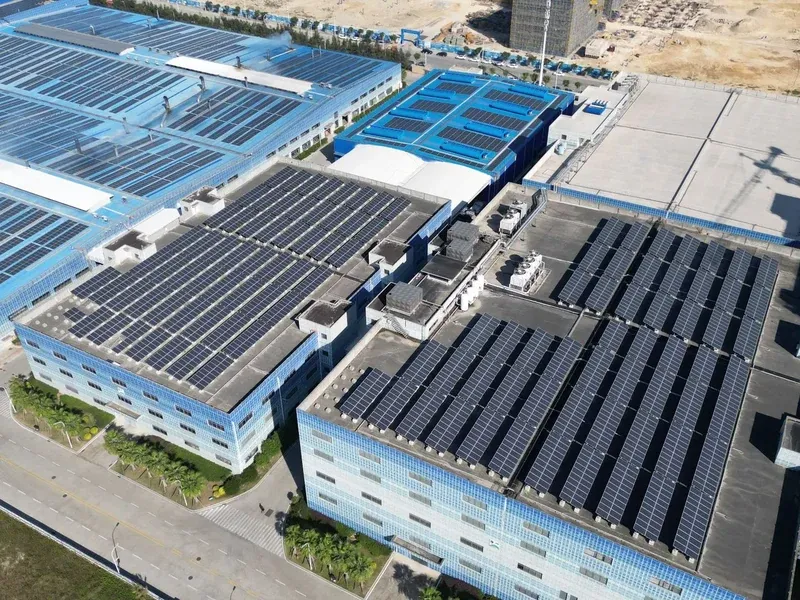
There is a second effect that the averages hide. On a framed module that is nearly flat, water and dirt collect along the lower edge and dry into a band. A field study on metal factory roofs in China saw those bands in every month of the year at one site. At another it compared a string with bands against one whose bands had been cleaned by hand, and found a mean difference in current of 4.7% over a summer, with peaks near 20%.
Scope and disclosure. This article is about tilt and cleaning: why low-tilt arrays collect more dirt, what the studies and 12 panel makers say, and what to check on a flat roof. How often to clean in general is in How Often Should You Clean Solar Panels?, how much rain does in Does Rain Clean Solar Panels?, water quality in Can You Clean Solar Panels With Tap Water?, and measuring soiling in How to Measure Solar Panel Soiling Loss. We are WaterSprayElephant and we make PV cleaning equipment; Section 8 sets out what we look at on a low-tilt roof.
1. Why a low tilt collects more dust and holds on to it
Dust mostly arrives by settling, and a flat surface catches the most. A 2014 review of dust-loss studies by Sayyah, Horenstein and Mazumder says dust accumulation falls as the inclination moves up from horizontal, and adds that “a thin layer of dust deposited on a horizontal surface cannot easily be removed by wind, even at a relatively high velocity (50 m/s).” IEA PVPS Task 13’s report on soiling losses agrees in general terms: soiling losses typically decrease as tilt angles increase for a given location, at least where wind plays no big part in removing dust.
Rain is supposed to make up for a low tilt, and the evidence for that is thinner than the manuals suggest. A 2024 field study of rain cleaning in Solar RRL by Norde Santos and co-authors found no relationship between tilt and rain cleaning, possibly because all its modules had similar, quite low tilts (8° to 18°). The authors still expect more cleaning on steeper modules: “higher levels of cleaning are expected for higher tilt angles”.
The frame adds its own problem. Cui, Xiao, Xiang and Sun, in a 2021 paper on soiling at the bottom edge of modules, point out that “the frame typically extends approximately 1–3 mm above the front glass, enabling water, dust, and dirt to easily accumulate at the bottom of the module”. Small amounts of rain, snow, dew, frost or cleaning water, they say, are usually not enough to move dust up over that lip. Once a pool has formed, “it is difficult to clean the stagnant area through natural causes, including moderate rainfall”. When the water evaporates, the dirt is left as a band with the shape of the pool.
2. What the tilt comparisons measured
The tilt comparisons we found are old and we only have them second-hand, through the 2014 review. Keep that in mind for everything in this section.
The most complete set is Nahar and Gupta’s, from the Thar desert in India between 1986 and 1987. They left glass plates outdoors at 0°, 45° and 90°, cleaned some daily and some weekly, and measured how much light got through. Figure 1 shows the worst readings. Among the plates cleaned daily, flat glass lost up to 6.28% of its transmission in May, against 4.62% at 45° and 1.87% when vertical. Among the plates cleaned weekly, the worst period was April to May, and the figures were 19.17%, 13.81% and 5.67%.
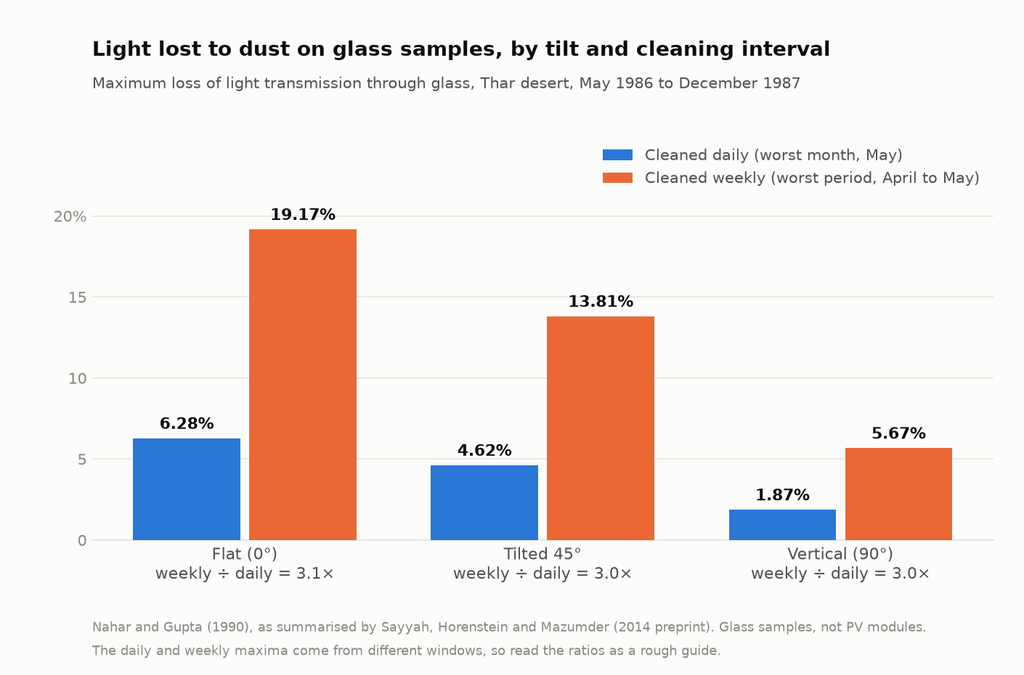
Flat against 45° comes to 1.36 for the daily set and 1.39 for the weekly set (our division). Flat against vertical is about 3.4 in both. The cleaning interval moved the result more than the angle did: weekly cleaning gave roughly three times the loss of daily cleaning at every tilt (3.05, 2.99 and 3.03). A 45° plate cleaned weekly (13.81%) lost more than a flat plate cleaned daily (6.28%). Dust storms in a desert are a hard case, and the two maxima do not cover the same weeks, so this is a hint about order of size, not a rule.
Two more comparisons come from the same review. Elminir and co-authors mounted glass samples at several tilts and azimuths in Minia, Egypt, and report a maximum loss of 27.62% for the horizontal sample against 4.94% for one tilted at 90° and facing southeast, a ratio of 5.6 (our division). The review gives no exposure time. In Taiyuan, China, six outdoor modules were watched for two weeks, and output at 45° and 0° fell by about 1.3% and 2.32% a day. That is a ratio of 1.8, over a short window in a city the review calls severely polluted.
The Thar and Taiyuan comparisons have nothing between 0° and 45°, which is where flat-roof arrays and the makers’ thresholds sit. What the three show is the direction of the effect. How much worse 5° is than 15° is not something they can tell you.
3. The lower edge, where the loss concentrates
A module’s cells are wired in series, so the dirtiest cell sets the pace. Cui and colleagues put it this way: “Even if only one cell is covered fully or partially, the current flowing through the PV module will be affected due to the series connection of the cells”. That is why a clean-looking panel can still be losing a lot of output. The paper is short and its authors call it non-systematic: photographs from metal-roofed industrial and commercial stations in central and eastern China, plus one current comparison at one site.
The photographs are the striking part. The authors report that “soiling bands were widespread, even in Guangzhou city, where annual rainfall is approximately 1,800 mm”. At a station in Xi’an, tilted at about 3°, bands showed up in every month of the year, July to September included, when heavy rain is frequent. The roofs are nearly flat: “the tilt angle of the metal roof is typically 2–3° and the PV modules lie flat on the roof”. And rain helps less than you might hope. In the authors’ words, “the thickness of the soiling band gradually increased with instances of light or moderate rainfall, and then suddenly decreased to zero with heavy rainfall”. Their photographs from Xi’an show the bands gone in July 2019 and May 2020, both taken after heavy rain.
For the measurement they used a station in Kaifeng, tilted at about 4°. Two inputs of one inverter, side by side and closely matched in the weeks before, were compared from 19 June to 2 October 2019. The bands on one input were cleaned by hand and the other was left alone. The hand-cleaned input averaged 8.57 A and the control 8.19 A, which the paper gives as a mean relative difference of 4.7% (the rounded means work out at 4.6%). The peak was about 20% on 3 September, after two light rain events and one moderate one. There were also 14% on 28 July and 10% on 27 June. A summer mean of 4.7% and a peak of 20% come from the same two inputs. The authors describe the difference growing through spells of light or moderate rain and dropping back after thunderstorms, so what a band costs depends on when you look.
One detail of the design matters: “MPPTS one refers to the experimental group with no soiling band due to manual cleaning; however, the area not covered by soiling bands was not cleaned.” So the difference is what the bands cost on top of ordinary dust, and it is a current, not a power, measurement. The authors think 4.7% is on the low side, because thunderstorms between June and September clean the bands at Kaifeng: “That means the RD of 4.7% is smaller than that in any other months, and even the annual RD.” It is one site, one summer and one pair of inputs.
Table 1. Four reports of loss from bottom-edge soiling bands. Only the first was read at source; the other three come through the same 2021 paper.
| Report | Tilt | What was measured | Result |
|---|---|---|---|
| Cui et al. 2021, Kaifeng, China (read at source) | about 4° | Difference in daily maximum current between a string with hand-cleaned bands and an uncleaned control, 19 June to 2 October 2019 | Mean 4.7%; peaks of about 20% (3 September), 14% (28 July), 10% (27 June) |
| Gostein et al. 2015, as cited by Cui | about 5° | Power loss from a band covering 0.5% of a module’s area, at a pre-construction survey station in the south-west US; cleared only by rain over 5 mm | 9% at peak |
| Yan and Yao 2018, as cited by Cui | about 3° | Power loss with 5 to 10 cm bands along the bottom of long-edge-down modules, rooftop station in Shanxi, China | 20% to 26.7% |
| Ibrahim 2011, as cited by Cui | not given in the passage | Energy yield loss for cells with bands on the edge of framed cells | Up to 10–20% |
The Gostein case is worth a second look. A band covering 0.5% of the module’s area cost 9% of its output at peak, which is 18 times its share of the area (our division). The wiring explains it. Ilse and co-authors report that “the shading of only 50% of a single solar cell due to dust accumulation can trigger the bypass diode of one string, which can reduce the power production of a typical three-string module by one third”.
The IEA PVPS Task 13 report describes the same pattern from the monitoring side: “light rain or condensation can cause partial cleaning of tilted modules and the accumulation of soiling at the bottom row of cells”. It adds that when a string of soiled cells is bypassed, the loss shows up in power but not in short-circuit current, so “the short circuit current measurements might underestimate the actual impact of soiling on the PV power”. If you rely on a soiling sensor or a reference cell, that matters. Our measurement article covers how soiling loss is measured.
The same papers list slower costs, none of them given a rate. “Temperature differences of up to 23°C have been observed between non-covered cells and cells covered by soiling bands” (Lorenzo and co-authors, via Cui). Cui and colleagues add that “this water can damage the seal and eventually reduce the service life of PV modules”, meaning the stagnant water behind the frame. LONGi’s maintenance manual makes related claims: “long-term accumulation of water on the bottom edge of the module will corrode the glass surface”, and “the uneven shielding of the bottom edge of the module will cause abnormal heating in the area”. Treat these as warnings from the literature, not as measured rates.
4. What 12 panel makers write about tilt
We searched the 13 documents from 12 makers (the same set we used in earlier articles) for places where a tilt or angle word sits near a cleaning, dust or rain word, and read what turned up. Table 2 has the result, ordered by the angle each maker gives.
Table 2. What each maker’s document says about tilt and cleaning. Quotation marks mean verbatim; the other wording is ours.
| Maker | Angle given | What the document says |
|---|---|---|
| Qcells | minimum 3° | No link to cleaning frequency. On water: “Standing water on the modules glass needs to be avoided.” |
| Maxeon | minimum 5° | “To reduce soiling, modules should be mounted at a minimum of 5 degrees. The cleaning frequency must be increased for modules installed with a very low angle.” |
| Trina Solar | not less than 10° | “The module with too small tilt angle requires more frequent cleaning”. Tilt also aids drainage, to prevent water standing and leaving stains. |
| Risen Energy | more than 10° | Tilt lets rain wash the dust away, and “the module with too small tilt angle requires more frequent cleaning”. |
| Aiko | not less than 10° | “PV modules installed at an adequate tilt angle will allow rainwater to clean the PV module surfaces, thereby reducing the cleaning frequency.” |
| Astronergy | no less than 10° | “Astronergy recommends an installation tilt angle of no less than 10°, so that the dust on surface can be easily carried away by the rainwater while raining, in order to reduce the number of times of clean.” |
| Canadian Solar | at least 15° | “Modules with sufficient tilt (at least 15°), generally may not require cleaning (rain will have a self-cleaning effect).” |
| REC | no angle given | “the lower the angle of installation, the more cleaning will be required”. Its quick guide adds that rain cleans modules naturally if they are installed at a sufficient angle. |
| JinkoSolar | no angle given | “For modules with a smaller installation tilt, dust accumulation tends to be more severe.” It recommends increasing the cleaning frequency after visual inspection. |
| LONGi | no angle given | Water and dirt stay on the lower edge, “particularly obvious in the installation of the roof/factory distributed scene with a small inclination angle”. |
| First Solar | none | Nothing that links tilt and cleaning in the user guide we read. |
| JA Solar | none | The cleaning leaflet we read (Portuguese) does not mention tilt. |
Where a number is given, it runs from 3° to 15°: Qcells 3°, Maxeon 5°, four makers at 10° (Trina Solar, Risen, Aiko and Astronergy) and Canadian Solar at 15°. Take an array at 8°. It clears two of those lines and falls below five (our count). The thresholds are about rain washing dust off, and the wording is hedged: Canadian Solar says modules tilted at least 15° “generally may not require cleaning”, which is not a promise.
That 8° to 18° span is the one the Norde Santos study covered, and inside it the study found no relationship between tilt and rain cleaning. It doesn’t contradict the manuals, since all its modules were low, but it doesn’t show a step at 10° or 15° either. The thresholds look like rules of thumb rather than measured steps.
On how much more cleaning, the makers are as vague as the studies. Jinko gives the most to work with: “it is recommended to clean the modules at least once a month”, adjusted to conditions, with more cleaning for smaller tilts once the glass has been checked by eye. LONGi gives general intervals only: “In rainy areas, it is recommended to clean at least once in 40-50 days; in dry areas with little rain, it is recommended to clean at least once in 20-30 days.” Neither ties an interval to tilt, and none of the 12 makers does.
5. If you can still choose the tilt
A 2025 conference paper from Brazil (Curioni, Starke and da Silva) modelled how dust moves the best annual tilt for panels that are never cleaned. In Florianópolis the best angle for a clean panel is 29°. At PM10 levels of 10, 50 and 100 µg/m³, the best angle shifts up by 1°, 5° and 14°. Across Brazilian cities the largest shift was 7°, for a whole year without cleaning or rain.
So in that model dust raises the best tilt by a few degrees at ordinary pollution levels and by more only at heavy ones. The model deposits dust by tilt, exposure time and PM10. It has nothing on bands at the frame, it leaves rain out (the authors list it as future work), and the authors say themselves that it needs experimental validation. We would not design a roof around it. If you can choose between, say, 5° and 10° racking, four makers’ 10° lines (Table 2) give you something to point to, though nothing measured shows a step at 10°. What the steeper rack costs in roof area, row spacing and wind loading is a question for your designer.
6. Where the evidence runs out
None of the studies cited here compares 5°, 10° and 15° under the same conditions, which is the comparison a flat-roof owner needs. The tilt comparisons are old glass samples seen through a review. The band measurement comes from one summer at one site, and three of the four figures in Table 1 are second-hand.
One gap matters to anyone holding a brush. The 2021 paper says there are no systematic studies of the bands’ “effective removal methods” and lists them as future work, so the best way to clear a band had no systematic study behind it when the paper was written.
There is no multiplier to be had. The manuals say ‘more’. The Thar data move about threefold with the cleaning interval and about 1.4-fold between 45° and flat. One field paper puts the difference a hand-cleaned band made at 4.7% of current over a summer. Those are different quantities on different bases, so we keep them apart instead of merging them into one figure.
7. What to check on a flat or low-tilt array
Start with the lower edge. After a drizzle or a damp morning, look along the bottom row of cells. A band of grime against the frame means the rain is not clearing it. LONGi’s manual is blunt about partial dirt: “If the module/cell is partially obscured by dirt, the module must be cleaned.”
Check the drain holes. Four makers tell installers not to block them: Qcells wants them uncovered, Canadian Solar says they should not be blocked, and REC says no part of the mounting structure may cover them. Maxeon goes a step further: “Do not block drain holes or allow water to pool in or near module frames.” Qcells also asks that rain and melting snow can run off freely. A rail across a drain hole puts the pool back.
Don’t count on rain for the bands. In Cui’s photographs light and moderate rain cleaned only the glass outside them, and the Gostein band cleared only after more than 5 mm. Our rain article covers what ordinary rain does for ordinary dust.
Watch where your rinse water goes. Cui and colleagues say cleaning water, like small amounts of rain, is usually not enough to move dust up the frame, and Jinko notes that “the minerals in the water will deposit on the glass surface as the water evaporates”. Jinko caps water hardness at 450 mg/L and total dissolved solids at 1000 mg/L. On a flat array, check whether the rinse dries on the lower edge. Water quality is in our tap-water article.
On frequency there is no tilt-specific figure to give. Start from the interval that suits your site (our frequency article has the numbers) and let the lower edge decide when you clean, since the middle of the glass will look fine long before the edge does. Jinko’s manual points the same way: “it is recommended to increase the cleaning frequency based on the cleanliness of the module surface after visual inspection”.
8. What we look at on a low-tilt roof
We are WaterSprayElephant, and we make PV cleaning equipment. Before we recommend a cleaning method for any array, we review the PV layout, panel tilt, module gaps, dust conditions, water access and power supply, and all seven of our product pages say so. For a flat or low-tilt roof, tilt and water access are the two items on that list that this article has the most to say about.
Our R1 and R2 crawler robots are specified for working angles up to 20°, which takes in every tilt threshold in Table 2 (3° to 15°), and the G3U cleaner has a brush head that adjusts up to 30° for closer contact on suitable arrays. The R1 page adds that actual suitability also depends on module surface, weather, track condition and array geometry.
The G4, R1 and R2 can also run dry, which uses no water; our pages describe dry cleaning for loose dust and suitable module conditions after a site assessment. If you are planning cleaning for a low-tilt roof, send us the tilt, the layout, the module gaps and your water and power access, and we will review them before recommending a method.
Frequently asked questions
Do flat solar panels need more cleaning?
Most makers say so. Nine of the 12 whose documents we read link low tilt to more cleaning, and desert and Egyptian field comparisons found flat glass losing 1.4 to 5.6 times as much light as tilted or vertical glass (Sections 2 and 4). No source says how much more often.
What is the minimum tilt angle for solar panels to clean themselves in the rain?
There is no guaranteed angle. The makers that give one say 3° (Qcells, as a minimum), 5° (Maxeon), 10° (Trina Solar, Risen, Aiko, Astronergy) and 15° (Canadian Solar, whose modules ‘generally may not require cleaning’ above it). A field study at 8° to 18° found no link between tilt and rain cleaning (Section 4).
How often should I clean flat or low-tilt solar panels?
No source gives an interval for low tilt. Jinko suggests at least monthly in general, with more cleaning for smaller tilts after a visual check, and LONGi gives general intervals of 40 to 50 days in rainy areas and 20 to 30 days in dry ones. Inspect the lower edge, which is where the dirt collects (Sections 4 and 7).
Why is there a dirty band along the bottom edge of my solar panels?
Water and dirt collect against the frame, and when the water evaporates a band of dirt is left in the shape of the pool. In the study that photographed these bands, light and moderate rain cleaned only the glass outside them and heavy rain cleared them (Sections 1 and 3).
Does rain clean low-tilt solar panels?
Partly. In the Chinese rooftop photographs, light and moderate rain cleaned the glass outside the bands but not the bands. Another field study found no relationship between tilt and rain cleaning between 8° and 18°, and expected more cleaning at higher tilts (Sections 1 and 3).
Can dirt on one edge cut the output of a whole module?
Yes. The cells are in series, and the paper on bottom-edge bands reports a 4.7% mean difference in current at one site and 9% to 26.7% losses in other studies it cites. One of those reports that a half-covered cell can trigger a bypass diode and cut a typical three-string module by a third (Section 3).
Sources
- Cui, Y.-Q., Xiao, J.-H., Xiang, J.-L. and Sun, J.-H., Characterization of Soiling Bands on the Bottom Edges of PV Modules, Frontiers in Energy Research 9 (2021) (soiling bands, the Kaifeng current comparison, and the Gostein, Ibrahim, Yan and Yao, Ilse and Lorenzo figures as cited there; open access, read at source)
- Sayyah, A., Horenstein, M. N. and Mazumder, M. K., Energy Yield Loss Caused by Dust Deposition on Photovoltaic Panels, preprint submitted to Solar Energy, 7 May 2014 (Nahar and Gupta, Elminir and Taiyuan figures as summarised there; second-hand)
- Soiling Losses: Impact on the Performance of Photovoltaic Power Plants (IEA PVPS Task 13, T13-21:2022) (tilt and soiling; partial cleaning at the bottom row of cells; short-circuit current)
- Norde Santos, F. et al., Cleaning of Photovoltaic Modules through Rain: Experimental Study and Modeling Approaches, Solar RRL (2024) (no tilt effect between 8° and 18°)
- Curioni, A. S., Starke, A. R. and da Silva, A. K., Optimization of the Tilt Angle of Residential Photovoltaic Panels Considering Dust Accumulation, ISES Solar World Congress 2025 Proceedings (modelled; the authors call for experimental validation)
- Module-maker documents: First Solar, Trina Solar, Canadian Solar, JinkoSolar, Aiko, LONGi, Risen Energy, Astronergy, JA Solar, Qcells, Maxeon, REC (installation manual), REC (quick cleaning guide). JA Solar’s leaflet is in Portuguese. Document titles and dates are in the links above.
- WaterSprayElephant product pages retrieved 23 November 2026: G1, G2U, G3, G3U, G4, R1, R2 (working angle, brush-head adjustment, cleaning modes and our site review, as listed)