PV cleaning equipment manufacturer
PV cleaning equipment manufacturer


Do You Need to Turn Off Solar Panels Before Cleaning Them? What 12 Manuals and Safety Reports Say
Do you need to turn off solar panels before cleaning? Five of 12 maker manuals say disconnect, yet sunlit panels stay live. What switching off really does.

The short answer
Our reading: for cleaning, most of the makers that say anything tell you to disconnect first, but switching off does not make a sunlit panel dead, and the text that governs your warranty is your own maker’s. Of the 12 makers whose manuals we read (13 documents), five write a disconnect or open-circuit step into the cleaning instructions (First Solar, Trina Solar, Canadian Solar, JinkoSolar and Aiko), two have only a general rule for maintenance or repair (Risen Energy and REC), one recommends cleaning while the inverter is not started (LONGi), and four give no switch-off instruction for cleaning (Maxeon, Qcells, Astronergy and JA Solar). Yet 11 of the 12 say modules generate current or are live when lit, and five say the risk applies whether or not the module is connected.
Three things decide what to do. What “off” achieves depends on the system: NREL says that when AC is lost the inverters shut down automatically but the strings connected to a string inverter remain energised, while each power optimizer outputs only 1 V. Where the shock risk is named is narrower than “a live panel”: cracked or broken modules, wet connectors and terminals, and water on cables or the back of the module. What nobody has published is a measured shock current for hosing an intact module, or the voltage an array still holds in low light.
The practical rule, in our judgement: follow your maker’s wording and your installer’s written shutdown procedure, treat the array as live anyway, inspect for damage before any water touches it, keep water off connectors, cables and the junction box, and stop and call a professional if anything is damaged or unclear. Section 7 is a checklist. This is not an electrical procedure for your system.
Scope and disclosure. This article is about the electrical state of the array while you clean it. Water quality is in Can You Clean Solar Panels With Tap Water?, pressure, bristles and water temperature in Can You Pressure Wash or Brush Solar Panels?, overhead power lines and non-conductive poles in Can You Clean Solar Panels With a Water-Fed Pole?, and how often to clean in How Often Should You Clean Solar Panels? WaterSprayElephant makes PV cleaning equipment, so we have an interest in this question. We are not electricians, we have not measured any current, and nothing here says that any product of ours is safe or permitted on an energised array.
1. What the 12 manuals say about switching off
Figure 1 sorts the 12 makers on three questions. The sort is ours: a cell says “says so” only where the manual has a sentence to that effect, and Table 1 gives the sentences. Some manuals put the switch-off rule in the cleaning clause; others only in a general maintenance or installation rule, and we say which.
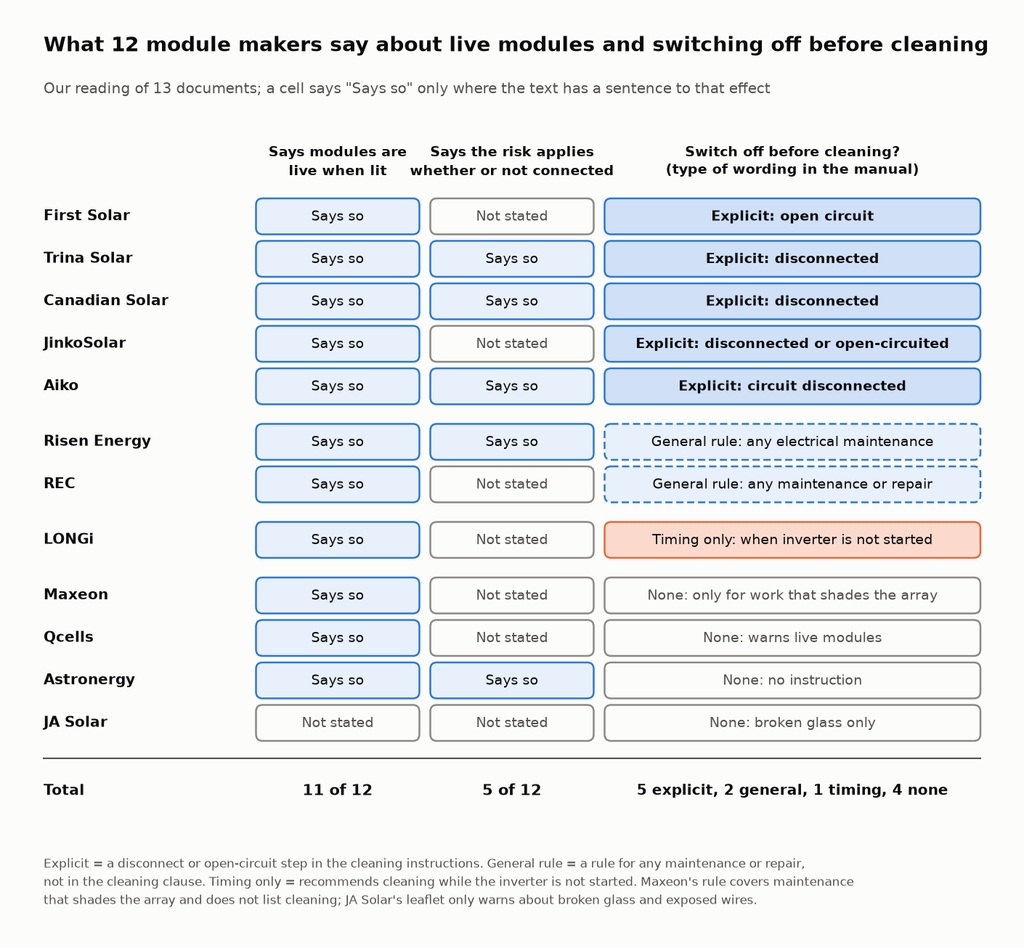
Table 1. Wording on switching off before cleaning, for the eight makers that say anything about it. Quotation marks mean the words are verbatim. “Leaves open” is our reading.
| Maker | What the text says | What it leaves open |
|---|---|---|
| First Solar – User Guide REV 2.5, section 8.2 | “Clean modules only when in open circuit (reference Section 7.6 Module Shading Considerations) – either disconnected from load, or during times when the inverter is off.” “The recommended time to clean modules is from dusk to dawn when production is not affected and risk of electrical shock hazard is minimized.” | Gives two ways to be in open circuit and says nothing about system types. Elsewhere it calls the voltage in daylight sufficient for a lethal shock, including in low light (Section 2). |
| Trina Solar – Vertex manual, Method C | “Please make sure that the array has been disconnected from other active components before starting the cleaning.” | “Other active components” is not defined, and there is no switch-off sequence. |
| Canadian Solar – US edition v3.3, section 8 | “Ensure that the circuit is disconnected before starting the cleaning procedure, as contact with leakage of electrically active parts can result in injury.” “Ensure that the array has been disconnected to other active components (such as inverter or combiner boxes) before starting with the cleaning.” | Names the inverter and combiner boxes as the things to disconnect from, but not how. |
| JinkoSolar – Cleaning Manual v1.0 | “Before starting the cleaning operation, please ensure the system is disconnected or the modules are open-circuited to guarantee electrical safety.” | Allows either route; it does not say which suits which system. |
| Aiko – V35 2609, section 9.1 | “Safety power-off: Before cleaning, ensure the circuit is disconnected. Contact with exposed live parts may cause injury.” | Says “the circuit”; it does not say which circuit. |
| Risen Energy – manual A1[2026], section 12.2 | In the maintenance section, just before the cleaning section: “Warning: Any electrical maintenance must shut down the PV system firstly.” The cleaning section itself asks for insulating gloves and says “To reduce potential electric shocks or burns, suggest cleaning the PV modules in the early morning or evening when the sunlight is weak and the temperature is low”. | Does not say whether cleaning counts as “electrical maintenance”. |
| REC – Alpha Pure installation manual REV 18, “Special installations” | “Isolate the system and remove/open the inverter AC fuse/circuit breaker from the grid before carrying out any maintenance or repair work.” Its cleaning instructions do not repeat this. | A general rule, not a cleaning step; the cleaning page ends with “if in doubt” (Section 7). |
| LONGi – O&M manual v02, section 2.2.2 | On timing: “it is recommended to clean modules when the inverter is not started”. | A recommendation about timing, not a switch-off rule, and not tied to the inverter’s state on a cloudy day (Section 6). |
The four makers with no switch-off instruction for cleaning
Maxeon says “Systems should be disconnected in any cases of maintenance which can cause shading”, with chimney sweeping, roof maintenance and antenna or dish installation as its examples; its cleaning section does not repeat the rule. It also says “Do not disconnect any modules when its inverter is feeding in to the grid.” Qcells’s cleaning clause opens with “Risk of injury due to hot and live modules!” and “Do not carry or wear any electrically conductive parts.” It adds that “module cleaning has to be done by qualified personnel”, according to the state of the art and the relevant safety issues, but gives no disconnect step. Astronergy’s safety chapter says the danger of touching live parts applies whether or not the module is connected (Section 2). It also says to follow the cleaning requirements and adds “the connectors must be kept dry and clean to ensure that they are in good working condition”; its cleaning section (7.2) covers water, brushes and timing and has no electrical step. JA Solar’s leaflet exists only in Portuguese in the copy we found; by our translation it says: “Do not try to clean broken glass or modules with broken lines or exposed wires, as this can cause electric shock.” It says nothing about switching off.
None of this means these four think a hose is safe on a working array. It means their cleaning text does not say. We read their silence as a gap, not as permission, and the sections below show what they say about live modules in general.
Why the manuals differ
In our reading, the texts were written for different readers. Some are installation manuals with a cleaning page added, and the electrical rules sit in the safety chapter; others are standalone cleaning guides. Several carry near-identical sentences: First Solar, Trina Solar, Canadian Solar and REC’s quick guide all have the same run of ideas on cracked modules, wet modules and inspection before cleaning, which in our reading points to a common source or copying; we cannot tell which came first. We found no manual that explains why it chose one switch-off route over another, which is the gap Section 3 tries to narrow.
2. Why switching off does not make a sunlit panel dead
A module generates direct current whenever light reaches the cells. Five makers go further and say the danger does not depend on whether the module is wired up. Trina Solar says contact with live parts such as terminals can result in injury or death, “irrespective of whether or not the module and the other electrical equipment are connected”. Canadian Solar’s version is “irrespective of whether or not the module and the other electrical equipment have been connected”. Astronergy writes: “Whether the module is connected or not, direct contact with the live part of the module such as the wiring terminal may cause personal injury or even death.” Aiko opens its protection rule with “Regardless of whether the module is electrically connected or not”, and Risen warns of touching connectors or terminals “no matter whether the modules are connected or not”.
Low light does not remove it. First Solar says “a single module or multiple interconnected modules can create a lethal shock hazard during daylight hours, including periods of low light levels.” Qcells says “a solar module generates electrical current and voltage even at a low intensity of illumination.” LONGi writes “Even in the case of dim sunlight, the array still has a very high voltage”, and adds “On cloudy or rainy days, sunlight will penetrate the thin cloud layer, and modules will generate voltage.” First Solar’s guide gives a figure for its own modules: “Series 6 Plus modules may produce up to 280 Volts DC (VDC) and up to 4.0 A when exposed to sunlight.”
LONGi puts the consequence plainly: “PV modules do not have a switch, and modules can only be stopped by avoiding sunlight or shielding them with cloth, cardboard or completely opaque materials.” REC’s manual says: “To prevent the panels automatically generating current (electricity) when exposed to light, shield the system with a non-transparent cover during installation, maintenance or repair work.” Trina Solar says “Please cover the front surface of modules with an opaque material during repairing.” and adds “modules exposed to sunlight can generate high voltage, which is extremely dangerous.”
What the fire-safety literature adds
Two bodies that study PV from the firefighter’s side describe the same physics. The IEA PVPS Task 12 report says: “While exposed to the sun, PV systems remain energized, even after a building’s connection to the grid has been disabled.” UL’s research summary says: “Turning off an array is not as simple as opening a disconnect switch.” “As long as the array is illuminated, parts of the system will remain energized.” It adds: “Unlike a typical electrical or gas utility, a PV array has no single point of disconnect.” These documents are about emergencies and not about cleaning, but they describe the same system, and they say that an open disconnect is not the end of the story.
On US “rapid shutdown” equipment, the IEA report describes the 2017 edition of NEC 690.12(2): “An 80 V limit was included as option 2 in article 690.12 (2) for a ‘rapid shutdown’ within an array boundary.” It gives the reason: “Because conventional PV modules typically obtain over 40 V in open-circuit conditions, the new 80 V limit implicitly requires additional electronics for each module.” It also warns that a marking should not be read as meaning the equipment is off inside the array boundary, “because sunlit modules and their conductors will remain energized after ‘shutdown’.” We do not know which NEC edition applies where you live, or whether your system has module-level devices; your installer will.
Should you cover the array with something opaque? Trina Solar and REC mention covers for repair and maintenance work, but none of the 12 makers presents covering as a cleaning method. UL says of tarps that “if light can be seen through a tarp, the tarp should not be used” and that “a wet tarp may become energized and conduct hazardous current if it contacts live equipment”. That is a firefighting finding on damaged equipment, and we are not suggesting a cover for cleaning; we cite it because a cover is not a simple off switch either.
3. What turning it off actually switches off, by system type
The manuals say “disconnect”, “open circuit”, “inverter is off” and “isolate the system”, which are different actions. First Solar means “either disconnected from load, or during times when the inverter is off”; Trina Solar asks for the array to be disconnected “from other active components”, and Canadian Solar adds “(such as inverter or combiner boxes)”; REC means “remove/open the inverter AC fuse/circuit breaker from the grid”. What each leaves energised depends on how the system is built. The sources we found that set this out are NREL’s O&M guide (section 5.2.2) and the IEA report.
Table 2. What stays energised after the AC side is opened, by system type, from the sources named in each row. Our reading in the last column.
| System type | What the source says | What it leaves open |
|---|---|---|
| String inverter | NREL: “Micro-inverters and string inverters shut down automatically as required by IEEE 1547 upon loss of AC connection, and only the strings of modules connected to the string inverter remain energized.” | NREL’s sentence means the DC strings in the array stay energised while lit. Section 5 has a forum poster’s voltage figure for string systems, which is an opinion with no measurement. |
| Microinverters | NREL, same sentence: they shut down automatically on loss of AC. | NREL gives no voltage for the wiring between each module and its microinverter, and we found no figure. |
| Power optimizers | NREL: “Each power optimizer will output only 1 V, meaning that the string connecting the modules to the inverter is also de-energized.” | The 1 V is per optimizer; NREL does not say what is at the module’s own terminals. |
| US rapid-shutdown systems | IEA: “An 80 V limit was included as option 2 in article 690.12 (2) for a ‘rapid shutdown’ within an array boundary.” | This is IEA’s 2017 description of the 2017 NEC; we did not read later editions. Whether your array has module-level devices depends on where and when it was built, and your installer will know. |
How you switch off matters as much as what you switch off. REC says “once current is flowing, breaking a connection (e.g., disconnecting two panels) can cause an electrical arc.” LONGi says “please do not disconnect the electrical connection when there is a load.” Maxeon says “do not disconnect any modules when its inverter is feeding in to the grid.” REC also says “Do not connect the system to the inverter during solar exposure.” In our reading, that means “turning it off” is done with the installed isolators and breakers, in the order your installer gives, not by pulling connectors apart on a sunlit array.
We did not find any manual that gives a step-by-step switch-off sequence for cleaning, or any that says what a homeowner should do with a battery system, a hybrid inverter or a system with a generator. If you have one of those, the installer’s procedure is the only source that fits your case.
4. Where the manuals locate the shock hazard
The hazards the texts name are narrower than “panels are live”. Reading across the 12, they cluster in four places.
- Damaged modules. Seven of the 12 (First Solar, Trina Solar, Canadian Solar, REC, LONGi, JA Solar, Maxeon) name broken, cracked or exposed parts as a shock hazard. First Solar: “Cracked or broken modules represent a shock hazard due to leakage currents and the risk of shock increases when modules are wet.” Trina Solar and Canadian Solar use almost the same words, and REC’s quick guide has “Damaged panels can present a lethal shock hazard due to leakage currents. The risk of shock is higher when panels are wet.” First Solar, Trina Solar and Canadian Solar all follow with “Before cleaning, thoroughly inspect modules for cracks, damage, and loose connections.” Aiko asks for an inspection for “electrical leakage hazards” as well. LONGi says “to prevent the risk of electric shock, do not clean PV modules with broken glass or exposed cables.”
- Wet connectors and terminals. JinkoSolar says “Due to the risk of electrical shock, any work cannot be performed if the terminals of the PV module are wet.” Trina Solar writes: “Please ensure that the connectors are clean and dry to prevent electric shock and fire hazards.” LONGi has the same sentence.
- Water on the back, cables or junction box. Three of the 12 say so. Trina Solar says it is “forbidden the injection of water to the backside of the modules or cables”. LONGi says “do not splash water on the cables.” JinkoSolar says “take care not to directly wash the junction box with water and always keep connectors clean and dry to prevent electrical hazards.”
- The person. JinkoSolar asks you not to wear “metal rings, watches, and other metal products”, and Qcells says “do not carry or wear any electrically conductive parts.” Four makers (First Solar, Trina Solar, Aiko, Risen Energy) ask for insulating protective equipment during cleaning; Risen adds “the gloves should withstand DC voltages of no less than 2000V” and First Solar says “only properly trained personnel who understand the risks of applying water to electrical components should clean modules.”
The IEA report’s hazard table says the same from the firefighters’ side: “Electrical shock or burn injury by coming into contact with or spraying water on energized conductors (broken yet still energized modules or exposed wires).” For hose operators it says “employing a fine spray of water (rather than a continuous stream) where energized conductors may be exposed is important in reducing the potential shock hazard to the hose operator.” That is written for fire hoses, and we do not know of an equivalent statement for cleaning, but it is the closest published sentence linking the style of water to shock risk.
What is missing. We found no published measurement of the leakage or shock current a person would receive from hosing an intact module, none that compares a dry brush with a wet one, and none on how far low-light voltage persists. In our reading, the manuals’ consistent focus on damage, wet connectors and water in the wrong places points to where the practical risk sits, but it is an inference from what they warn about, not a measured result.
5. What online advice says, and why it conflicts
Search results for this question disagree. We read four web pages and one forum thread and treat them as opinions: none cites a measurement or a manual clause.
- Turn it off. Bob Vila: “Solar panels are electrical equipment and cannot be cleaned while active due to the risk of electric shock.” Solar Energy World says “you should shut down the system completely”, giving the reason that “turning off your solar panels helps to minimize the risk of electrical shock should the connections become too wet.” Onesto says “Always turn off solar panels before cleaning them.” and, of manufacturers, “They usually tell you to shut down your system before you start cleaning.”
- Off is not the whole answer. Onesto also warns: “Some people think turning off the big switches near the inverter makes cleaning safe. That is not always true.” “Solar panels keep working when sunlight hits them.” “You should not assume that flipping a switch makes everything safe.”
- You do not need to. The Green Watt says “For a standard hose-and-brush cleaning, you do not need to shut down the system”, because “water on the glass surface of an operating panel creates no electrical hazard — the electrical connections are sealed behind the junction box on the back, and the front glass is an insulator.” The same page also says “Panels still produce voltage in daylight even when disconnected — treat all DC wiring as live”.
- The forum view. In a March 2024 Solar Panel Talk thread, one poster wrote that “string systems may operate at a very lethal 400VDC, not good to mix with water”.
They conflict for three reasons we can see. First, they answer different questions: whether water on intact glass is hazardous, versus whether any work near energised conductors is. Second, “off” does not mean the same thing to each author, as Table 2 shows. Third, none of the five cites a test, and The Green Watt gives no source for its statement that the front glass is an insulator, while five of the 12 manuals write a disconnect into their cleaning text. Our judgement: where a web page and a maker’s manual disagree, follow the manual, and note that even the page that says no shutdown is needed tells you to treat DC wiring as live.
6. Does cleaning at low light make it safe?
Several manuals tell you when to clean, and the reasons given are mixed. First Solar’s guide ties the hour to shock: “The recommended time to clean modules is from dusk to dawn when production is not affected and risk of electrical shock hazard is minimized.” It says “minimized”, not removed, and the same guide says the shock hazard exists “during daylight hours, including periods of low light levels”. Risen suggests early morning or evening and gives the reason: “To reduce potential electric shocks or burns”. JinkoSolar’s timing clause gives “200W/m2” as an upper limit and Aiko says to “Clean PV modules under low irradiance conditions” (both are about irradiance, which falls at dawn, dusk and under cloud). LONGi gives “recommended irradiation ≤200W/m2” as well, and then reminds you that “on cloudy or rainy days, sunlight will penetrate the thin cloud layer, and modules will generate voltage.”
JinkoSolar’s stated reason for cooler hours is “to avoid thermal stress and risk of damage”, not shock, and REC’s is thermal shock to the glass. In our reading, cleaning at dawn or dusk helps with heat and, if you are switching off, with lost production. It lowers current, but none of the manuals says it lowers voltage enough to make the array safe to touch. We have no figure for how much energy a switch-off window costs; it depends on the hour, the season and the system.
One caution about open circuit
First Solar also says, in a different section, “Risk is highest when modules are disconnected (i.e., in open circuit) prior to system energization or during curtailment events.” The passage is about modules sitting in open circuit under prolonged heat, before the system is energised or during curtailment, mainly in hot desert climates, and the guide does not link it to cleaning. Our reading is that a short cleaning window is not what it addresses, but if you run First Solar modules in a hot climate and cut production for long periods, ask the maker.
7. A checklist before you clean
- Read your maker’s cleaning text first. Table 1 shows the wording differs, and a switch-off step may be missing. If it is, ask the maker or your installer in writing.
- Find out what kind of system you have (string inverter, microinverters, optimizers, rapid-shutdown devices) and ask for the installer’s written shutdown procedure (Table 2). Check whether you have a battery or hybrid inverter, which none of the manuals covers.
- Switch off with the installed isolators and breakers, not by pulling connectors apart. REC, LONGi and Maxeon all warn against breaking a live DC connection (Section 3).
- Treat the array as live anyway. Five makers say the risk applies whether or not the module is connected, and IEA and UL both describe sunlit arrays staying energised after shutdown (Section 2).
- Inspect before water touches anything. If you see cracks, broken glass, exposed cables or loose connections, do not clean it; have it looked at (First Solar, Trina Solar, Canadian Solar, REC, LONGi, JA Solar).
- Keep water off connectors, cables, the junction box and the back of the module, and make sure connectors are dry (Trina Solar, LONGi, JinkoSolar).
- Take off metal and wear insulating protection where the maker asks for it (JinkoSolar, Qcells, First Solar, Trina Solar, Aiko, Risen Energy).
- Look up before you extend anything. Overhead lines and conductive tools are a separate hazard; see the water-fed pole article. Stay off the array while you work.
- If in doubt, stop. REC says: “If in doubt at any time when cleaning the panels, stop and obtain professional advice.” First Solar notes that “professional cleaning services trained to work on live electrical systems are available for hire.”
Kind Tips
WaterSprayElephant makes manual water-fed brushes and cleaning robots. Ask us and your module maker in writing before using any equipment on a live array.
Frequently asked questions
Do you need to turn off solar panels before cleaning them?
Five of the 12 makers we read write a disconnect or open-circuit step into their cleaning instructions (First Solar, Trina Solar, Canadian Solar, JinkoSolar and Aiko), two have a general maintenance rule and four give no switch-off instruction for cleaning. Check your own maker’s text and your installer’s procedure; Section 1 has the wording.
Does switching off the inverter make solar panels safe to clean?
Not by itself. IEA says “while exposed to the sun, PV systems remain energized, even after a building’s connection to the grid has been disabled.” NREL says that after loss of AC, “only the strings of modules connected to the string inverter remain energized” on a string-inverter system. Five makers say the risk applies whether or not the module is connected. See Sections 2 and 3.
Can you get shocked cleaning solar panels?
The manuals say the hazard is real and name where it sits: cracked or broken modules, wet connectors and terminals, and water on cables, the junction box or the back of the module. We found no measurement of the current from hosing an intact module, so we cannot give a figure. See Section 4.
Is it safe to hose down solar panels while they are working?
The sources disagree. One web page says no shutdown is needed for hose-and-brush cleaning, while First Solar says to clean only in open circuit and five makers write a disconnect step into their cleaning text. Section 5 explains the conflict; our judgement is to follow your maker’s text.
How do you turn off solar panels for cleaning?
The manuals say what to achieve (disconnect, open circuit, inverter off) but not how, and the right steps depend on whether you have string inverters, microinverters or optimizers. Use the installed isolators and breakers in the order your installer gives. See Section 3.
Is it safer to clean solar panels at night or when it is cloudy?
It reduces current and heat, but the manuals do not say it makes the array safe to touch. LONGi says that on cloudy days modules still generate voltage, and First Solar says the shock hazard exists in low light. See Section 6.
Sources
- First Solar — Series 6 Plus and Series 6 Plus Bifacial Modules User Guide, MPD-00895-06-G REV 2.5 (10 July 2026), sections 2 and 8.2 (daylight shock hazard, open circuit, dusk to dawn, damaged modules, PPE, open-circuit temperature note)
- Trina Solar — Vertex Series user manual, UM-M-0002 Ver. M (February 2025), section 2 and Method C (copy hosted by a third-party catalogue; disconnect before cleaning, regardless of connection, no water to the back or cables)
- Canadian Solar — Installation manual for PV modules, US-Rev IM/GN-EN/3.3 (July 2026), sections 2 and 8, Annex B (disconnect before cleaning, regardless of connection, damaged modules)
- JinkoSolar — Photovoltaic Modules Cleaning Manual, Version 1.0 (8 October 2024), sections 2, 5 and 8 (distributor copy; disconnect or open-circuit, wet terminals, metal items, junction box, timing)
- Aiko — PV Modules Installation Manual, V35 2609 (September 2026), sections 3.3 and 9.1 (safety power-off, regardless of connection, inspection, PPE)
- LONGi — PV Module Operation and Maintenance Manual, version 02 (January 2024), sections 1.3.1, 2.2.2 and 2.2.3 (no switch on a module, dim sunlight, inverter not started, no disconnecting under load, cables)
- Risen Energy — PV module installation and maintenance manual, edition A1[2026], sections 12.2 and 12.3 (shut down for electrical maintenance, insulating gloves, early morning or evening)
- REC — Alpha Pure installation manual, REF PM-IM-23-06 REV 18 (March 2026), IEC edition, ‘Safety measures’ and ‘Panel maintenance’ (isolate before maintenance, opaque cover, arcing, solar exposure) and REC — Quick guide to cleaning (undated) (damaged panels, professional advice)
- Maxeon — Safety and installation instructions, Rev J (December 2025), sections 2.0, 5 and 6.0 (cables under load, broken glass, shading maintenance, switch off the inverter first)
- Qcells — Installation manual, revision 11 (September 2026), sections 6 and 8 (live modules, low illumination, conductive items, qualified personnel)
- Astronergy — PV module installation manual, Rev 3.0 (August 2026), sections 3.1 and 7.2 (live whether connected or not, dry connectors)
- JA Solar — Cleaning method of JA Solar PV modules’ glass, Portuguese edition (2022) (broken glass and exposed wires; English wording in this article is our translation)
- IEA PVPS Task 12 — Photovoltaics and Firefighters’ Operations: Best Practices in Selected Countries, Report IEA-PVPS T12-09:2017 (Namikawa et al., April 2017) (systems stay energised, shock hazard table, fine spray, US rapid shutdown and the 80 V limit)
- UL — UL Fire Safety Journal, Issue 1 (New Science series; undated; summarises UL’s firefighter-safety and photovoltaic installations research) (turning off an array, no single point of disconnect, tarps)
- NREL — Best Practices for Operation and Maintenance of Photovoltaic and Energy Storage Systems, 3rd edition, NREL/TP-7A40-73822 (December 2018), section 5.2.2 (string inverters, microinverters and optimizers after loss of AC; full text at osti.gov)
- Bob Vila — How to Clean Solar Panels and Solar Energy World — Should You Turn Off Solar Panels Before Cleaning Them? and Onesto — Do I need to turn off the solar panels during cleaning? (web pages that say to turn off)
- The Green Watt — How To Clean Solar Panels: Step-By-Step Guide (published April 2026; says routine hose-and-brush cleaning needs no shutdown)
- Solar Panel Talk forum — “Cleaning panels”, page 2 (March 2024) (one poster’s view, not a test)
- WaterSprayElephant product pages retrieved 11 November 2026: G1, G2U, G3, G3U, G4, R1, R2 (no mention of switching off, shock or insulation)