PV cleaning equipment manufacturer
PV cleaning equipment manufacturer

How Much Water Does It Take to Clean Solar Panels? What the Published Figures Say
How much water does it take to clean solar panels? A review of 250 papers gives 0.31 to 4.95 L/m², or about 0.6 to 10 L for a 2 m² panel.

The short answer
A review of about 250 papers reports water use for cleaning of 0.31 to 4.95 litres per square metre of panel, with an average of 2.1 L/m². We use it as the baseline because it summarises many studies instead of one site. For a 2 m² panel it comes to 0.62 to 9.9 L, and 4.2 L at the average. Per MWp, one wash takes 1,550 to 24,750 L. The average is 10,500 L.
Treat the digits with some care. The pv magazine report of the review does not say whether 2.1 L/m² is per wash or per year. We could not open the paper, so we treat the figures as per wash, which is how the other sources state theirs. The sources also differ a great deal: a forum poster washing with a water-fed pole reports about 1.9 L a panel, and a vendor’s test in India used over 10 L on a panel when water was cast from cups or a hose.
Per year, the total is the per-wash figure times the number of washes. At the review’s average, monthly washing takes about 126 m³ per MWp and weekly washing about 546 m³. NREL’s operating-water figure for PV is 26 gallons per MWh. If a megawatt-peak yields 1,500 MWh a year, that converts to about 148 m³ per MWp-year, or roughly 14 washes at the average. None of the 13 module-maker documents we searched states a water quantity, and our own product pages give only a maximum flow. Neither settles the question.
Scope and disclosure. This article covers how much water cleaning takes: per square metre, per panel, per MWp and per year. How often to clean is in How Often Should You Clean Solar Panels?, water quality in Can You Clean Solar Panels With Tap Water?, pressure and brushes in Can You Pressure Wash or Brush Solar Panels?, and dry versus wet methods in Dry vs Wet Solar Panel Cleaning. The tap-water article quoted a rough 0.4 to 4.5 L per panel for hose and pressure washing without a single source; the range here is built from published figures and its top end, 9.9 L for a 2 m² panel, is 2.2 times higher. WaterSprayElephant makes PV cleaning equipment, so we have an interest in this question. Our product pages give a maximum water flow and nothing per square metre, per panel or per MW, so this article offers no consumption figure for our products and does not compare them with anything.
1. What the published figures say
Four sources put a figure on the water used in one cleaning. That makes six readings, because CEEW splits normal and arid areas and Polywater reports two tests. Figure 1 puts them on one axis, litres per square metre, by dividing the per-panel figures by 2 m². None of the sources states a panel size. The divisor is ours, and a different module shifts every per-panel point in proportion.
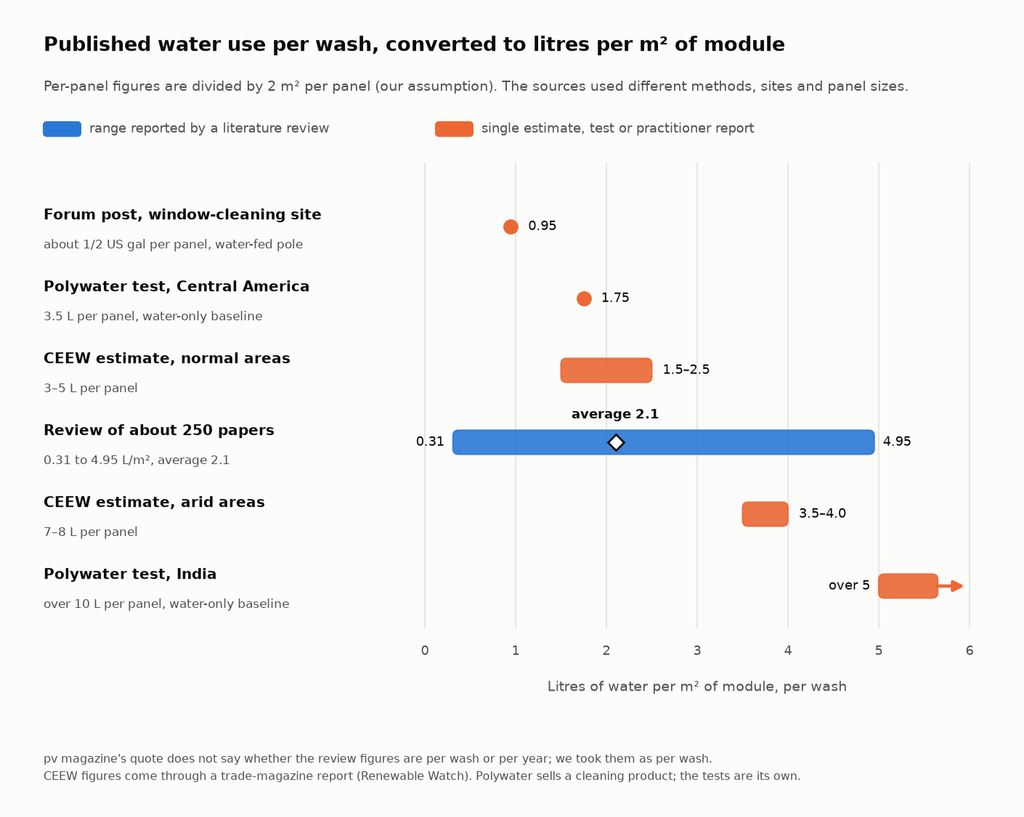
Table 1. The four sources, with the wording of each figure. Quotation marks mean the words are verbatim; the L/m² column is our conversion except for the review, which is published in that unit.
| Source | What it says | In L/m² | What it leaves open |
|---|---|---|---|
| Review of about 250 papers, University of Science and Technology of China (Renewable and Sustainable Energy Reviews, 2025), as reported by pv magazine on 4 February 2025 | “The minimum water consumption for aqueous cleaning is 0.31 L/m2, the maximum is 4.95 L/m2, and the average water consumption is 2.1 L/m2.” | 0.31–4.95, average 2.1 | No time basis in the quote. We could not open the paper. No split by method, climate or dust type. |
| CEEW (Council on Energy, Environment and Water) as reported by Renewable Watch, 3 December 2020 | “The amount of water needed to clean a single solar panel is 3-5 litres per panel in normal areas and 7-8 litres in arid areas.” “This means that for a 1 MW solar park with about 3,000 panels, up to 24,000 litres of water would be required.” | 1.5–2.5 normal; 3.5–4.0 arid | Second-hand: we found no CEEW publication. No panel size or method. |
| American Polywater, blog PDF (2021), two field tests, water-only baseline | India: “over 10 L of water were used to clean and rinse a panel using only untreated local water.” Central America: “it was estimated that 3.5 L of water were needed for soaking and rinsing each panel when water only was used.” | over 5 (India); 1.75 (Central America) | Written by a vendor of a cleaning additive. No panel size. Water was cast onto the panels, from cups, pails or a hose. |
| Window Cleaning Resource forum, post by ‘leavingnc’, 9 December 2020 | “Running off the 40 gal tank in my van, I’m able to use about 1/2 gal per panel.” | 0.95 | One person’s report. No panel size or soiling. A US gallon is 3.785 L. |
The review is the only one of the four that covers many studies. Its authors, at the University of Science and Technology of China, went through 250 articles published up to 2024. The water figures sit in a passage that also says weekly water cleaning can effectively eliminate dust contamination, so they may refer to a weekly wash, and the quote does not say which. The publisher’s page returned an access error to our download tool. What we know of the paper is what pv magazine printed.
Renewable Watch attributes the next set to the Council on Energy, Environment and Water. The context is India, and the magazine says CEEW estimates weekly cleaning for dry and arid areas. We found no CEEW document to check against. The magazine’s example of up to 24,000 L for a 1 MW park of about 3,000 panels is 8 L a panel, the top of its arid range.
American Polywater sells a cleaning additive, and its two field tests are written up to show the additive saving water. We leave those savings aside, because the comparison changes the product and the application method together, and take only the water-only baselines. The India baseline was over 10 L a panel, and the write-up’s table splits it into 5.0 L to clean and 5.0 L to rinse. In Central America it was 3.5 L, 1.5 L plus 2.0 L. Rinsing took 50% and 57% of the total in the two tests. The forum post is one person’s report. They ran off a 40-gallon tank in a van and used about half a gallon, or 1.9 L, a panel.
Read together, the review’s average (2.1 L/m²) sits inside CEEW’s normal-area range (1.5 to 2.5), and so does the Central American test (1.75). The two high figures are both from India: CEEW’s arid-area range (3.5 to 4.0) and Polywater’s cast-water baseline (over 5). The low one is the forum post (0.95), the only source that describes a pole and a brush.
2. From litres per square metre to a panel, a kilowatt and a megawatt
Table 2 converts the review’s three numbers into the bases people plan around. We assume a module efficiency of 20% at the standard 1,000 W/m², which puts 5 m² of module in each kilowatt-peak and makes a 2 m² panel 0.4 kWp. A more efficient module needs less area per kilowatt, so it needs less water per kilowatt for the same litres per square metre.
Table 2. The review’s range on four bases, per wash if its figures are per wash. Our calculation, using 20% efficiency (5 m² per kWp) and 2 m² per panel.
| Basis (one wash) | Low | Average | High |
|---|---|---|---|
| Litres per m² (as published) | 0.31 | 2.1 | 4.95 |
| Litres per 2 m² panel | 0.62 | 4.2 | 9.9 |
| Litres per kWp | 1.55 | 10.5 | 24.75 |
| Litres per MWp | 1,550 | 10,500 | 24,750 |
A litre per square metre is a layer of water 1 mm deep. The average wash is like 2.1 mm of rain on the array, and the high figure is about 5 mm.
The other sources fit the same bases. CEEW’s 3 to 5 L per panel is 7.5 to 12.5 L per kWp at 0.4 kWp a panel, which brackets the review’s average of 10.5. Its 24,000 L for a 1 MW park is 24 L per kW, close to the review’s high of 24.75.
3. From one wash to a year
A year’s water is the per-wash figure times the number of washes. Table 3 runs four schedules: 1, 4, 12 and 52 washes a year. Weekly is the schedule that CEEW describes for India’s dry areas and that the review says can eliminate dust contamination. Choosing a schedule for your own site is the subject of our cleaning-frequency article.
Table 3. Water per MWp per year, in m³, for four schedules, using the review’s low, average and high figures. Our calculation: one wash is 1.55, 10.5 and 24.75 m³ per MWp.
| Washes per year | Low (m³) | Average (m³) | High (m³) |
|---|---|---|---|
| 1 (once) | 1.55 | 10.5 | 24.75 |
| 4 (quarterly) | 6.2 | 42 | 99 |
| 12 (monthly) | 18.6 | 126 | 297 |
| 52 (weekly) | 80.6 | 546 | 1,287 |
The schedule moves the total about as much as the choice of source. The review’s high figure is 16 times its low one, and weekly washing is 13 times quarterly. A site that washes weekly at the low figure (81 m³ per MWp-year) uses less than one that washes monthly at the average (126 m³).
A cross-check against NREL
NREL’s 2011 review of operational water factors gives utility-scale PV a median of 26 gallons per MWh, with values from 0 to 33 across three studies. The studies behind it date from 1989, 1993 and 2002, and NREL warns: “Because estimates are used as published, considerable methodological inconsistency is inherent, limiting comparability.” On cleaning it says only: “PV systems require occasional panel washing.”
To turn that into a year we assume a megawatt-peak yields 1,500 MWh, our assumption and one that varies a lot by site. Then 26 gallons per MWh is 98 L per MWh, or about 148 m³ per MWp-year, the same as about 14 washes at the review’s average. The top of NREL’s range, 33 gallons, is 187 m³ or about 18 washes. NREL’s median is therefore consistent with cleaning a little more often than monthly, though nobody can tell what schedule the three studies assumed.
Weekly washing at the review’s average comes to 96 gallons per MWh by the same conversion, 3.7 times NREL’s median. Leaving out hydropower, NREL puts the highest consumers at about 1,000 gallons per MWh: coal with carbon capture, and concentrated solar power with cooling towers. Even weekly washing at the average is under a tenth of that.
4. Why the figures differ
The sources name a few causes and give no way to weigh them. Among the water-cleaning parameters the review identified, pv magazine lists “water pressure, flow rate, diffusion angle, distance from the panel, and angle of incidence (AOI)”. On the dirt, the researchers say: “Scales formed by single mineral dust have little adhesion and are easily cleaned. Scales containing some biological dust and industrial dust are more challenging to clean”. CEEW roughly doubles its figure for arid areas, from 3 to 5 L to 7 to 8 L a panel.
Polywater says casting water onto a panel uses more than spraying it. Its own comparison also changes the product, so we cannot separate the two. It also says that cleaning in the heat of the day uses more water because the water evaporates faster, and it shows no measurement for that. None of the sources gives a breakdown that would let you pick a figure for your own site. The review’s quote has no split by method or climate, CEEW’s has no method, and Polywater’s baselines are single tests. For planning, use the range to size a water supply with room to spare, and measure a trial wash on your own array when the volume matters.
5. What manuals and our product pages say about volume
We searched the text of all 13 module-maker documents (12 makers, the same set we used in our ice and frost article) for litres, gallons, flow rates, cubic metres, per-square-metre figures and the words ‘water consumption’. None states a water quantity. What the manuals do give is pressure. First Solar’s cleaning section specifies “water pressure < 35 bar (500 psi) at nozzle”. JinkoSolar writes “it is recommended that the water pressure do not exceed 3500 kPa (35 bar)” and, for a hose or backpack-style set, “a water pressure less than 675kPa”. Aiko writes “Recommended maximum water pressure is 4MPa(40bar).” Pressure limits are covered in our pressure article. A pressure limit does not tell you how many litres a panel takes.
Waterless cleaning removes the volume question, and the manuals that mention it attach conditions. Trina Solar says: “If a cleaning robot is used for dry cleaning, the brush material is required to be soft plastic material”. Aiko has a near-identical sentence. Canadian Solar says: “Dirt must never be scraped or rubbed away when dry, as this will cause micro-scratches on the glass surface.” It adds: “The module damage due to improper dry cleaning method will void Canadian Solar’s warranty.” How the two methods compare on soiling removal is in our dry-versus-wet article.
Our own product pages, read on 18 November 2026, describe water as a maximum. The G2U, G3, G3U and G4 pages list a maximum water flow of 4 L/min. The R1 and R2 pages give a maximum water use of 1.84 L/min, and the G1 page an optional pump rated at 6.0 LPM and 60 psi (4.1 bar). These are ceilings. If you are comparing machines, ask each maker for litres per m² measured on a site like yours, with the soiling and the method stated.
6. Worked examples
A 6 kWp home array is 15 panels of 0.4 kWp, about 30 m². One wash takes 9.3 to 148.5 L, with 63 L at the average. Four washes a year at the average take 252 L.
A contractor with a 40-gallon (151 L) van tank covers about 80 panels at the forum post’s half a gallon each. At the review’s average of 4.2 L a panel the same tank covers about 36, and at its high figure of 9.9 L about 15.
A 100 MWp plant washed monthly at the average uses about 12,600 m³ a year. That is 12.6 million litres. The low and high figures give 1,860 and 29,700 m³.
Frequently asked questions
How much water does it take to clean one solar panel?
Published figures run from about 0.6 to 10 L for a 2 m² panel (0.31 to 4.95 L/m²). The average in a review of about 250 papers is 4.2 L. A forum post reports about 1.9 L a panel with a water-fed pole, and a vendor’s test in India used over 10 L when water was cast by hand (Section 1).
How much water does it take to clean solar panels per kW or per MW?
At 20% module efficiency, one wash takes 1.55 to 24.75 L per kWp and 1,550 to 24,750 L per MWp, with 10,500 L per MWp at the average. CEEW’s estimate for a 1 MW park is up to 24,000 L (Section 2).
How much water does a solar farm use for cleaning in a year?
It depends on the schedule. At the review’s average, a MWp uses 10.5 m³ for one wash, 126 m³ for monthly washing and 546 m³ for weekly washing. NREL’s 2011 operating figure for PV, 26 gallons per MWh, comes to about 148 m³ per MWp-year at an assumed 1,500 MWh (Section 3).
How does cleaning water compare with other power plants?
Leaving out hydropower, NREL puts coal with carbon capture and concentrated solar power with cooling towers at about 1,000 gallons per MWh, against a PV median of 26. Weekly washing at the review’s average works out to 96 gallons per MWh by our conversion, under a tenth of the top figure (Section 3).
Do solar panel makers say how much water to use?
Not in the 13 documents we searched. None gives a water quantity. Some give a pressure limit, for example 35 bar at the nozzle for First Solar and 40 bar for Aiko (Section 5).
Can you clean solar panels without water?
Dry cleaning exists, and some manuals set conditions for it: Trina Solar and Aiko require a soft plastic brush on cleaning robots, and Canadian Solar says dirt must never be scraped or rubbed away when dry. The dry-versus-wet article compares the two methods (Section 5).
Sources
- pv magazine: Pressurized water cleaning can improve PV generation efficiency by 10%, Lior Kahana, 4 February 2025 (the 0.31, 2.1 and 4.95 L/m² figures, the 250 articles, the weekly-cleaning sentence, dust types and cleaning parameters; our only access to the review)
- Combining dust scaling behaviors of PV panels and water cleaning methods, Renewable and Sustainable Energy Reviews, 2025 (the review behind the previous item; not read, because the publisher’s page returned an access error to our download tool)
- Renewable Watch: Waterless Way: Dry cleaning solutions for solar panels, 3 December 2020 (CEEW’s estimates as reported: weekly cleaning, 3–5 and 7–8 L per panel, up to 24,000 L for a 1 MW park; second-hand)
- American Polywater: Water Consumption in PV Panel Cleaning (2021) (two water-only baselines, India and Central America; vendor document, additive results not used)
- Window Cleaning Resource community: “Waterford pole on solar panels”, post by leavingnc, 9 December 2020 (about half a gallon per panel; one person’s report)
- NREL: Macknick, Newmark, Heath and Hallett, A Review of Operational Water Consumption and Withdrawal Factors for Electricity Generating Technologies, NREL/TP-6A20-50900, March 2011 (OSTI copy; median 26 gal/MWh for utility-scale PV, range 0 to 33 from three studies, methodological caveat, about 1,000 gal/MWh upper bound)
- Module-maker documents searched for water quantities (none found): First Solar, Trina Solar, Canadian Solar, JinkoSolar, Aiko, LONGi, Risen Energy, Astronergy, JA Solar, Qcells, Maxeon, REC (installation manual), REC (quick cleaning guide). Pressure limits from First Solar, JinkoSolar and Aiko; dry-cleaning conditions from Trina Solar, Aiko and Canadian Solar. JA Solar’s leaflet is in Portuguese. Document titles and dates are in our ice and frost article.
- WaterSprayElephant product pages retrieved 18 November 2026: G1, G2U, G3, G3U, G4, R1, R2 (maximum water flow or use, optional pump rating and cleaning mode as listed)