PV cleaning equipment manufacturer
PV cleaning equipment manufacturer

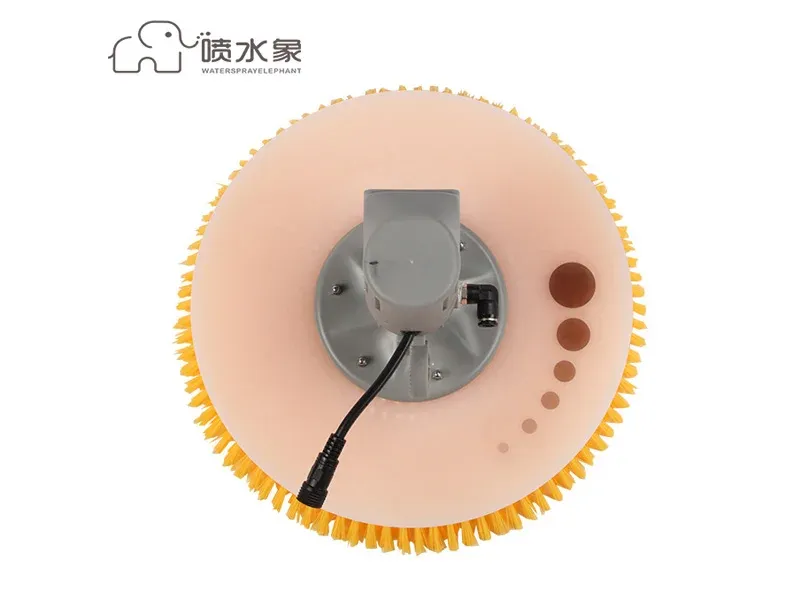
Beyond the Braid: How WaterSprayElephant Redefines PV Cleaning Brush Disc Design for Durability, Efficiency, and Ease of Maintenance

In photovoltaic (PV) module cleaning, the brush disc is the point of contact where cleaning actually happens—yet its design is often overlooked. This article examines four critical design flaws common in conventional brush discs, and presents WaterSprayElephant’s next-generation brush disc engineered with integrated tufted bristle technology, optimized water dispersion, reinforced drive connection, and smooth-contour geometry. Laboratory and field tests confirm significant improvements in bristle retention, water efficiency, motor protection, and cleanability.
1. Introduction: The Brush Disc – A Critical Component in PV Cleaning Equipment
In the ecosystem of photovoltaic cleaning equipment, much attention is given to motors, batteries, and control systems. But the brush disc—the component that physically contacts the solar panel surface—is arguably the most consequential part of any cleaning brush, brush machine, or cleaning robot. A poorly designed brush disc not only reduces cleaning effectiveness but can also damage the very panels it is meant to protect, increase water consumption, and shorten equipment lifespan.
WaterSprayElephant, as a specialized manufacturer of professional solar panel cleaning equipment—including automatic cleaning robots, roller brushes, and single and double head brushes—has invested heavily in brush disc R&D. This article details our latest design innovations that address four fundamental pain points found in conventional brush discs across the industry.
2. Four Design Flaws in Conventional Photovoltaic Cleaning Brush Discs
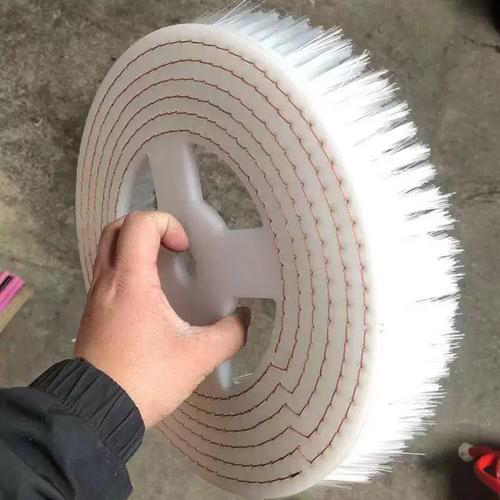
2.1 Braided Bristle Construction: A Reliability Risk
The vast majority of competing brush discs on the market today use a braided rope bristle construction rather than a tufted (planted) bristle process. While cost-effective to manufacture, this method introduces fundamental reliability problems:
- When the braided rope frays or its binding loosens under sustained mechanical stress and water exposure, individual bristle strands detach from the disc.
- Detached bristles can scratch or abrade the PV panel’s anti-reflective coating, permanently reducing energy yield.
- The braided construction creates deep crevices within the bristle bundle that trap dust, grit, and moisture—compromising both hygiene and cleaning consistency.
As shown in the figure below:
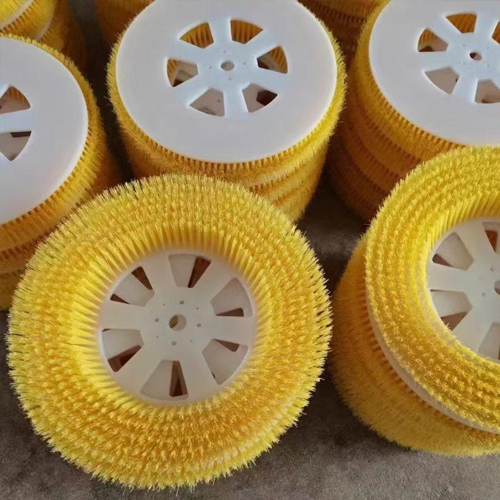
2.2 No Integrated Water Dispersion: Excessive Water Waste
Most brush discs lack any form of built-in water dispersion mechanism. Water is simply discharged through a central opening and allowed to flow unevenly onto the panel surface:
- Large volumes of water flow off the panel edges without contributing to cleaning effectiveness.
- Inconsistent wetting means some areas are over-wetted while others remain dry, compromising cleaning uniformity.
- For water-fed photovoltaic cleaning brush systems used in water-scarce regions such as the Middle East, this inefficiency is both economically and environmentally problematic.
As shown in the figure below:
2.3 Undersized Drive Connection: Excessive Motor Load
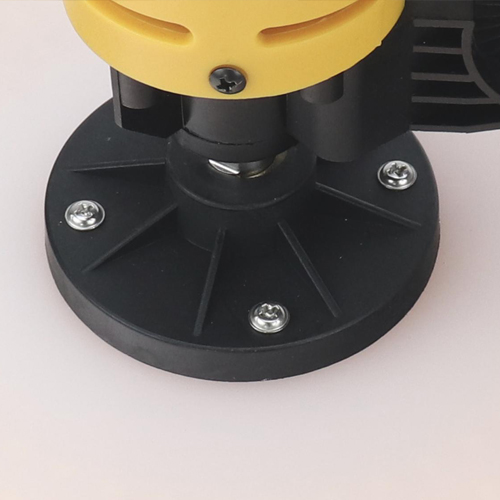
The drive connection transfers rotational force from the motor to the brush disc. In many competing designs, this connector is undersized relative to operating torque demands:
- A small connector creates a shorter effective lever arm, requiring the motor to deliver higher torque for the same brush speed and pressure.
- The resulting increase in motor load accelerates wear on bearings and windings, shortening service life.
- This is particularly problematic in heavy-soiling environments (desert, agricultural areas) where sustained cleaning torque is required.
As shown in the figure below:
2.4 Complex Surface Geometry: Dirt Accumulation
Conventional brush disc connectors and reinforcement ribs feature numerous sharp corners, recesses, and right-angle transitions:
- Dust and grime accumulate in every corner during operation, creating a surface that is difficult to clean.
- Over time, accumulated debris hardens and unbalances the rotating disc, introducing vibration and uneven wear.
- The unsightly appearance of a dirt-caked brush disc undermines the professional image that solar O&M teams present to stakeholders.
3. WaterSprayElephant’s Next-Generation Brush Disc Design
Responding to these industry-wide shortcomings, our R&D team—led by domain experts in electromechanical engineering—developed a comprehensively redesigned brush disc. The new design represents a significant advancement in PV cleaning brush technology.
3.1 Integrated Tufted Bristle Technology
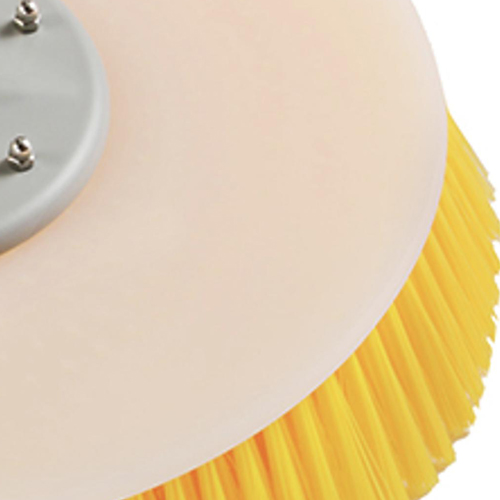
Our new brush disc employs an integrated tufted (planted) bristle process—the same high-precision technique used in premium toothbrushes. Individual bristle tufts are mechanically anchored into precision-drilled holes in the disc substrate, creating a permanent bond.
- Bristle retention is dramatically improved: no shedding, no fraying, no bare spots—even after extended use.
- The tufted structure eliminates the internal crevices that trap contaminants in braided designs.
- Bristle density and stiffness can be precisely controlled across different disc zones for optimized cleaning performance.
- This design is particularly effective for solar panel cleaning brush applications where consistent repeatable cleaning quality is essential.
As shown in the figure below:
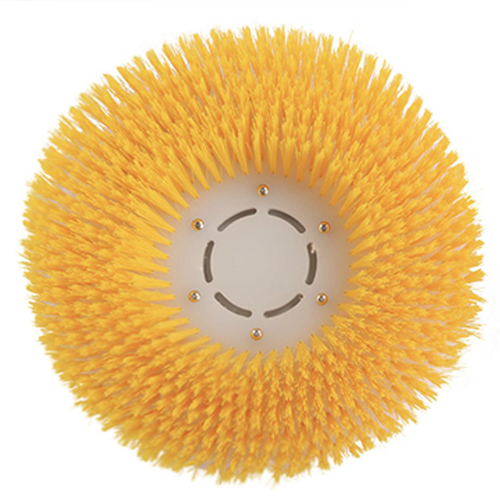
3.2 Engineered Water Dispersion Channels
Six precision-machined dispersion slots are now integrated into the brush disc body, arranged uniformly around the central water inlet. As the motor rotates the disc, centrifugal force drives water evenly through these slots, creating a controlled uniform spray pattern across the entire cleaning width.
- Water consumption is reduced by up to 30% compared to conventional central-discharge designs.
- Uniform wetting ensures consistent cleaning results across the full panel surface.
- The dispersion slots are self-cleaning—centrifugal force ejects debris during operation.
- This innovation is especially valuable for automatic solar cleaner systems operating in water-constrained environments.
As shown in the figure below:
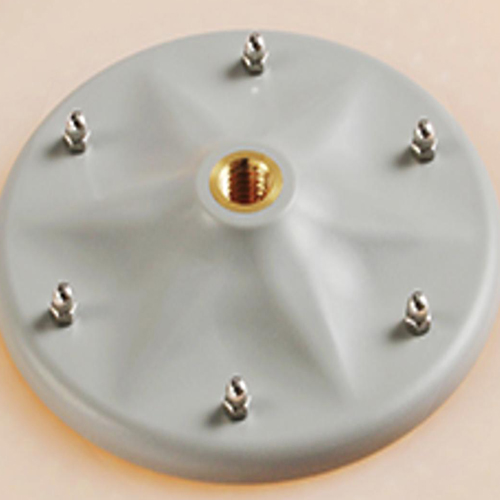
3.3 Enlarged Drive Connection for Optimal Torque Transfer
All reinforcement ribs and structural features employ smooth arc-shaped transitions rather than traditional right-angle corners:
- Without sharp corners and recesses, dust and grime have no place to accumulate.
- A quick water rinse restores the connector to a like-new appearance.
- The smooth surface reduces aerodynamic drag during rotation, contributing to marginal energy savings.
- Maintenance teams appreciate the visibly cleaner equipment—a small detail that reinforces a professional O&M standard.
As shown in the figure below:
4. Field Validation: Test Results
The redesigned brush disc has undergone extensive laboratory testing and field validation across multiple PV module cleaning system deployments:
| Parameter | WaterSprayElephant Design | Conventional Design |
| Bristle Retention | Zero bristle shedding after 500 hours continuous operation | Up to 15% shedding in braided designs |
| Water Consumption | ~30% reduction in water usage per panel, uniform spray | Uneven distribution, significant runoff waste |
| Motor Load | Measurable reduction in operating current | Higher current draw, accelerated motor heating |
| Cleanability | Simple water rinse restores original appearance | Requires manual scrubbing of corner deposits |
Customer feedback has been consistently positive. Field operators report noticeably better cleaning results, reduced water refill frequency, and fewer brush disc replacements over the maintenance season. As one solar farm O&M manager commented: “The new brush disc design simply works better and lasts longer. We have standardized on WaterSprayElephant brush discs for all our PV cleaning operations.”
5. About WaterSprayElephant
WaterSprayElephant (Xiamen WaterSprayElephant Cleaning Technology Co., Ltd.) is a technology enterprise specializing in the R&D and manufacturing of intelligent cleaning solutions for photovoltaic modules. With many years of industry experience, an R&D team led by three PhD experts, and multiple patented technologies, our product portfolio spans:
- Manual cleaning brushes and water spray brushes (manual cleaning brush, adjustable length cleaning brush)
- Single head cleaning brush and double head cleaning brush systems
- Roller brush cleaning machines for large-scale arrays
- Tracked and hanging solar cleaning robots for rooftop and ground-mounted PV modules
- PV dust measuring instruments and water filtration systems
Our solutions are deployed across 30+ countries in Europe, the Middle East, and Southeast Asia, consistently delivering a 5-20% improvement in PV energy yield through effective and reliable cleaning. We serve solar farm owners, O&M contractors, and EPC companies with customized solar cleaning solutions—whether for desert plants with heavy soiling, coastal installations requiring anti-corrosion protection, or flat single-axis tracker configurations.
6. Learn More
If you are responsible for solar farm maintenance and are evaluating ways to reduce O&M costs while increasing solar energy yield, contact our team to discuss your site conditions—panel type, soiling profile, tilt angle, and climate—and we will recommend the optimal cleaning configuration for your installation.
Visit: https://watersprayelephant.com
Email: Service@watersprayelephant.com